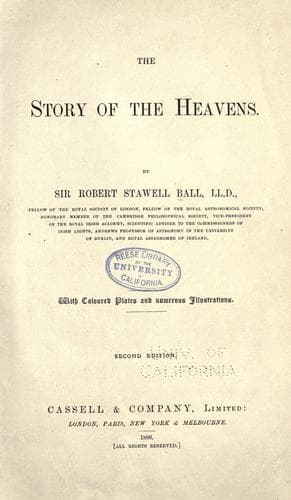
The Story of the HeavensBall, Robert S. (Robert Stawell)
History
The Story of the Heavens
Ball, Robert S. (Robert Stawell)
Astronomy
We can thus attribute to each ring a rotation which will partly relieve
it from the stress the arch would otherwise have to sustain. But we
cannot admit that the difficulty has been fully removed. Suppose that
the outer ring revolve at such a rate as shall be appropriate to
neutralise the gravitation on its outer edge, the centrifugal force will
be less at the interior of the ring, while the gravitation will be
greater; and hence vast stresses will be set up in the interior parts of
the outer ring. Suppose the ring to rotate at such a rate as would be
adequate to neutralise the gravitation at its inner margin; then the
centrifugal force at the outer parts will largely exceed the
gravitation, and there will be a tendency to disruption of the ring
outwards.
To obviate this tendency we may assume the outer parts of each ring to
rotate more slowly than the inner parts. This naturally requires that
the parts of the ring shall be mobile relatively to one another, and
thus we are conducted to the suggestion that perhaps the rings are
really composed of matter in a fluid state. The suggestion is, at first
sight, a plausible one; each part of each ring would then move with an
appropriate velocity, and the rings would thus exhibit a number of
concentric circular currents with different velocities. The
mathematician can push this inquiry a little farther, and he can study
how this fluid would behave under such circumstances. His symbols can
pursue the subject into the intricacies which cannot be described in
general language. The mathematician finds that waves would originate in
the supposed fluid, and that as these waves would lead to disruption of
the rings, the fluid theory must be abandoned.
But we can still make one or two more suppositions. What if it be really
true that the ring consist of an incredibly large number of concentric
rings, each animated precisely with the velocity which would be suitable
to the production of a centrifugal force just adequate to neutralise the
attraction? No doubt this meets many of the difficulties: it is also
suggested by those observations which have shown the presence of several
dark lines on the ring. Here again dynamical considerations must be
invoked for the reply. Such a system of solid rings is not compatible
with the laws of dynamics.
Public-domain text, read in full here on John Shaqi.
Reviews
Reviews
No reviews yet
Be the first to share your thoughts on this work.
Elsewhere in the archive
Join the Discussion
Join the discussion
Sign in to leave a comment or review.
Sign InorCreate an account