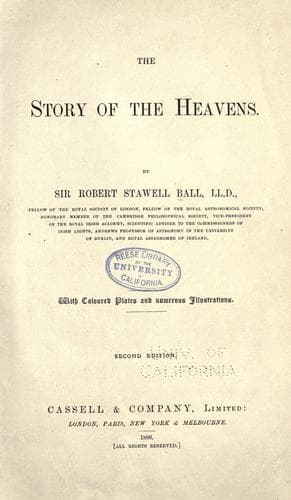
The Story of the HeavensBall, Robert S. (Robert Stawell)
History
The Story of the Heavens
Ball, Robert S. (Robert Stawell)
Astronomy
Let us suppose the case of the sun, and of two planets circulating
around him. These two planets are mutually disturbing each other, but
the amount of the disturbance is small in comparison with the effect of
the sun on each of them. Lagrange demonstrated that, though the ellipse
in which each planet moved was gradually altered in some respects by the
attraction of the other planet, yet there is one feature of the curve
which the perturbation is powerless to alter permanently: the longest
axis of the ellipse, and, therefore, the mean distance of the planet
from the sun, which is equal to one-half of it, must remain unchanged.
This is really a discovery as important as it was unexpected. It at once
removes all fear as to the effect which perturbations can produce on the
stability of the system. It shows that, notwithstanding the attractions
of Mars and of Venus, of Jupiter and of Saturn, our earth will for ever
continue to revolve at the same mean distance from the sun, and thus the
succession of the seasons and the length of the year, so far as this
element at least is concerned, will remain for ever unchanged.
But Lagrange went further into the enquiry. He saw that the mean
distance did not alter, but it remained to be seen whether the
eccentricity of the ellipse described by the earth might not be affected
by the perturbations. This is a matter of hardly less consequence than
that just referred to. Even though the earth preserved the same average
distance from the sun, yet the greatest and least distance might be
widely unequal: the earth might pass very close to the sun at one part
of its orbit, and then recede to a very great distance at the opposite
part. So far as the welfare of our globe and its inhabitants is
concerned, this is quite as important as the question of the mean
distance; too much heat in one half of the year would afford but
indifferent compensation for too little during the other half. Lagrange
submitted this question also to his analysis. Again he vanquished the
mathematical difficulties, and again he was able to give assurance of
the permanence of our system. It is true that he was not this time able
to say that the eccentricity of each path will remain constant; this is
not the case. What he does assert, and what he has abundantly proved, is
that the eccentricity of each orbit will always remain small. We learn
that the shape of the earth's orbit gradually swells and gradually
contracts; the greatest length of the ellipse is invariable, but
sometimes it approaches more to a circle, and sometimes becomes more
elliptical. These changes are comprised within narrow limits; so that,
though they may probably correspond with measurable climatic changes,
yet the safety of the system is not imperilled, as it would be if the
eccentricity could increase indefinitely. Once again Lagrange applied
the resources of his calculus to study the effect which perturbations
can have on the inclination of the path in which the planet moves.
Public-domain text, read in full here on John Shaqi.
Reviews
Reviews
No reviews yet
Be the first to share your thoughts on this work.
Elsewhere in the archive
Join the Discussion
Join the discussion
Sign in to leave a comment or review.
Sign InorCreate an account