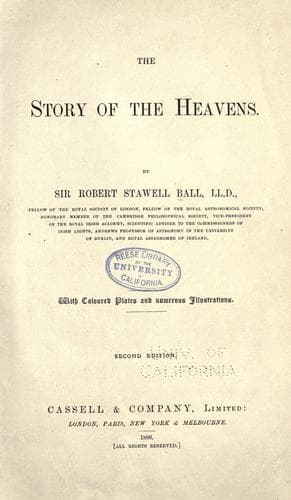
The Story of the HeavensBall, Robert S. (Robert Stawell)
History
The Story of the Heavens
Ball, Robert S. (Robert Stawell)
Astronomy
The
result in this case was similar to that obtained with respect to the
eccentricities. If we commence with the assumption that the mutual
inclinations of the planets are small, then mathematics assure us that
they must always remain small. We are thus led to the conclusion that
the planetary perturbations are unable to affect the stability of the
solar system.
We shall perhaps more fully appreciate the importance of these memorable
researches if we consider how easily matters might have been otherwise.
Let us suppose a system resembling ours in every respect save one. Let
that system have a sun, as ours has; a system of planets and of
satellites like ours. Let the masses of all the bodies in this
hypothetical system be identical with the masses in our system, and let
the distances and the periodic times be the same in the two cases. Let
all the planes of the orbits be similarly placed; and yet this
hypothetical system might contain seeds of decay from which ours is
free. There is one point in the imaginary scheme which we have not yet
specified. In our system all the planets revolve in the _same direction_
around the sun. Let us suppose this law violated in the hypothetical
system by reversing one planet on its path. That slight change alone
would expose the system to the risk of destruction by the planetary
perturbations. Here, then, we find the necessity of that remarkable
uniformity of the directions in which the planets revolve around the
sun. Had these directions not been uniform, our system must, in all
probability, have perished ages ago, and we should not be here to
discuss perturbations or any other subject.
Great as was the success of the eminent French mathematician who made
these beautiful discoveries, it was left for this century to witness the
crowning triumph of mathematical analysis applied to the law of
gravitation. The work of Lagrange lacks the dramatic interest of the
discovery made by Le Verrier and Adams, which gave still wider extent to
the solar system by the discovery of the planet Neptune revolving far
outside Uranus.
We have already alluded to the difficulties which were experienced when
it was sought to reconcile the early observations of Uranus with those
made since its discovery. We have shown that the path in which this
planet revolved experienced change, and that consequently Uranus must be
exposed to the action of some other force besides the sun's attraction.
Public-domain text, read in full here on John Shaqi.
Reviews
Reviews
No reviews yet
Be the first to share your thoughts on this work.
Elsewhere in the archive
Join the Discussion
Join the discussion
Sign in to leave a comment or review.
Sign InorCreate an account