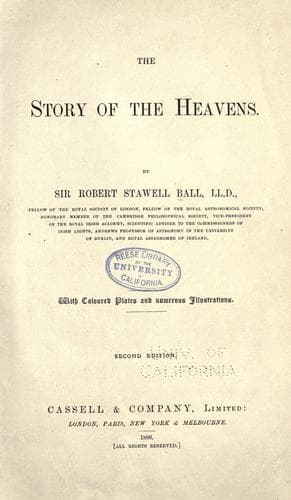
The Story of the HeavensBall, Robert S. (Robert Stawell)
History
The Story of the Heavens
Ball, Robert S. (Robert Stawell)
Astronomy
It was on the 23rd of September that Le Verrier's letter reached Dr.
Galle at Berlin. The sky that night was clear, and we can imagine with
what anxiety Dr. Galle directed his telescope to the heavens. The
instrument was pointed in accordance with Le Verrier's instructions. The
field of view showed a multitude of stars, as does every part of the
heavens. One of these was really the planet. The new chart was unrolled,
and, star by star, the heavens were compared with it. As the
identification of the stars went on, one object after another was found
to lie in the heavens as it was engraved on the chart, and was of course
rejected. At length a star of the eighth magnitude--a brilliant
object--was brought into review. The chart was examined, but there was
no star there. This object could not have been in its present place when
the chart was formed. The object was therefore a wanderer--a planet. Yet
it was necessary to be cautious in such a matter. Many possibilities had
to be guarded against. It was, for instance, at least conceivable that
the object was really a star which, by some mischance, eluded the
careful eye of the astronomer who had constructed the map. It was even
possible that the star might be one of the large class of variables
which alternate in brightness, and it might have been too faint to have
been visible when the chart was made. Or it might be one of the minor
planets moving between Mars and Jupiter. Even if none of these
explanations would answer, it was still necessary to show that the
object was moving with that particular velocity and in that particular
direction which the theory of Le Verrier indicated. The lapse of a
single day was sufficient to dissipate all doubts. The next night the
object was again observed. It had moved, and when its motion was
measured it was found to accord precisely with what Le Verrier had
foretold. Indeed, as if no circumstance in the confirmation should be
wanting, the diameter of the planet, as measured by the micrometers at
Berlin, proved to be practically coincident with that anticipated by Le
Verrier.
Public-domain text, read in full here on John Shaqi.
Reviews
Reviews
No reviews yet
Be the first to share your thoughts on this work.
Elsewhere in the archive
Join the Discussion
Join the discussion
Sign in to leave a comment or review.
Sign InorCreate an account