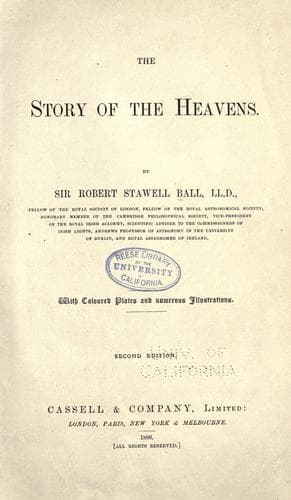
The Story of the HeavensBall, Robert S. (Robert Stawell)
History
The Story of the Heavens
Ball, Robert S. (Robert Stawell)
Astronomy
The world speedily rang with the news of this splendid achievement.
Instantly the name of Le Verrier rose to a pinnacle hardly surpassed by
that of any astronomer of any age or country. The circumstances of the
discovery were highly dramatic. We picture the great astronomer buried
in profound meditation for many months; his eyes are bent, not on the
stars, but on his calculations. No telescope is in his hand; the human
intellect is the instrument he alone uses. With patient labour, guided
by consummate mathematical artifice, he manipulates his columns of
figures. He attempts one solution after another. In each he learns
something to avoid; by each he obtains some light to guide him in his
future labours. At length he begins to see harmony in those results
where before there was but discord. Gradually the clouds disperse, and
he discerns with a certainty little short of actual vision the planet
glittering in the far depths of space. He rises from his desk and
invokes the aid of a practical astronomer; and lo! there is the planet
in the indicated spot. The annals of science present no such spectacle
as this. It was the most triumphant proof of the law of universal
gravitation. The Newtonian theory had indeed long ere this attained an
impregnable position; but, as if to place its truth in the most
conspicuous light, this discovery of Neptune was accomplished.
For a moment it seemed as if the French were to enjoy the undivided
honour of this splendid triumph; nor would it, indeed, have been
unfitting that the nation which gave birth to Lagrange and to Laplace,
and which developed the great Newtonian theory by their immortal
labours, should have obtained this distinction. Up to the time of the
telescopic discovery of the planet by Dr. Galle at Berlin, no public
announcement had been made of the labours of Challis in searching for
the planet, nor even of the theoretical researches of Adams on which
those observations were based. But in the midst of the paeans of triumph
with which the enthusiastic French nation hailed the discovery of Le
Verrier, there appeared a letter from Sir John Herschel in the
_Athenaeum_ for 3rd October, 1846, in which he announced the researches
made by Adams, and claimed for him a participation in the glory of the
discovery. Subsequent enquiry has shown that this claim was a just one,
and it is now universally admitted by all independent authorities. Yet
it will easily be imagined that the French _savants_, jealous of the
fame of their countryman, could not at first be brought to recognise a
claim so put forward. They were asked to divide the unparalleled honour
between their own illustrious countryman and a young foreigner of whom
but few had ever heard, and who had not even published a line of his
work, nor had any claim been made on his part until after the work had
been completely finished by Le Verrier. The demand made on behalf of
Adams was accordingly refused any acknowledgment in France; and an
Public-domain text, read in full here on John Shaqi.
Reviews
Reviews
No reviews yet
Be the first to share your thoughts on this work.
Elsewhere in the archive
Join the Discussion
Join the discussion
Sign in to leave a comment or review.
Sign InorCreate an account