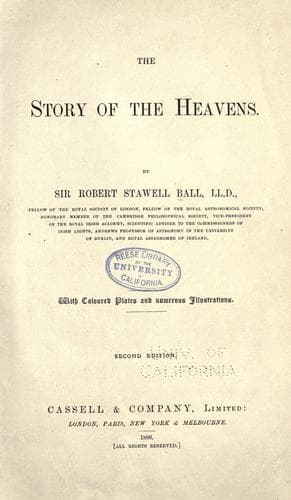
The Story of the HeavensBall, Robert S. (Robert Stawell)
History
The Story of the Heavens
Ball, Robert S. (Robert Stawell)
Astronomy
But as it sweeps through the solar system the comet may chance to pass
very near one of the larger planets, and, in passing, its motion may be
seriously disturbed by the attraction of the planet. If the velocity of
the comet is accelerated by this disturbing influence, the orbit will be
changed from a parabola into another curve known as a hyperbola, and the
comet will swing round the sun and pass away never to return. But if the
planet is so situated as to retard the velocity of the comet, the
parabolic orbit will be changed into an ellipse, and the comet will
become a periodic one. We can hardly doubt that some periodic comets
have been "captured" in this manner and thereby made permanent members
of our solar system, if we remark that the comets of short periods (from
three to eight years) come very near the orbit of Jupiter at some point
or other of their paths. Each of them must, therefore, have been near
the giant planet at some moment during their past history. Similarly the
other periodic comets of longer period approach near to the orbits of
either Saturn, Uranus, or Neptune, the last-mentioned planet being
probably responsible for the periodicity of Halley's comet. We have,
indeed, on more than one occasion, actually witnessed the violent
disturbance of a cometary orbit. The most interesting case is that of
Lexell's comet. In 1770 the French astronomer Messier (who devoted
himself with great success to the discovery of comets) detected a comet
for which Lexell computed the orbit, and found an ellipse with a period
of five years and some months. Yet the comet had never been seen before,
nor did it ever come back again. Long afterwards it was found, from most
laborious investigations by Burckhardt and Le Verrier, that the comet
had moved in a totally different orbit previous to 1767. But at the
beginning of the year 1767 it happened to come so close to Jupiter that
the powerful attraction of this planet forced it into a new orbit, with
a period of five and a half years. It passed the perihelion on the 13th
August, 1770, and again in 1776, but in the latter year it was not
conveniently situated for being seen from the earth. In the summer of
1779 the comet was again in the neighbourhood of Jupiter, and was thrown
out of its elliptic orbit, so that we have never seen it since, or,
perhaps, it would be safer to say that we have not with certainty
identified Lexell's comet with any comet observed since then. We are
also, in the case of several other periodic comets, able to fix in a
similar way the date when they started on their journeys in their
present elliptic orbits.
Public-domain text, read in full here on John Shaqi.
Reviews
Reviews
No reviews yet
Be the first to share your thoughts on this work.
Elsewhere in the archive
Join the Discussion
Join the discussion
Sign in to leave a comment or review.
Sign InorCreate an account