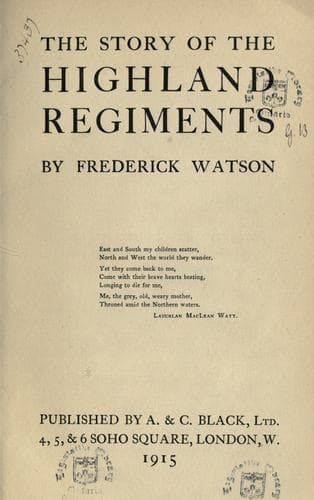
The Story of the Highland RegimentsWatson, Frederick
History
The Story of the Highland Regiments
Watson, Frederick
Great Britain. Army
After this unsatisfactory engagement Roberts decided that he would take
up position in Sherpur, evacuating Kabul since the people there were not
to be depended on, and it would be a difficult place to hold. The
numbers of the enemy had increased so largely that although many points
of vantage had been taken it was decided that concentration within the
limits of Sherpur was inevitable. Though Roberts had ample funds of
ammunition he could not reassure the Government that for the present any
decisive advance could be made. Trenches were hastily thrown up and wire
entanglements implanted, and shortly afterwards the attack upon Sherpur
commenced. Before dawn the noise, “as if hosts of devils had been let
loose,” came rolling out of the night, and through the darkness could be
dimly seen dense masses of the Afghans rushing upon the British
entrenchments, shouting again and again their frenzied battle-cry of
“Allah-il-Allah!”
The Gordon Highlanders were one of the first regiments to open fire upon
the immense force that threatened them. For three hours, despite the
terrible slaughter amongst their ranks, the Afghans rushed again and
again to the attack. At last it was evident that a counter-move would be
necessary to break the enemy’s determination to take Sherpur at all
costs. Moving out the cavalry with four guns, Roberts began to shell the
outlying villages. Distracted by this manœuvre, the Afghans’ assault
exhausted itself, and the moment for a counter-attack arrived. Suddenly
the cavalry swept down on their crowded masses, and in a moment the
enemy were in confused retreat. The end was come. Once in disorder they
scattered far and wide, pursued by every available man and horse. By
evening all the neighbouring country was perfectly silent, just as
though no battle had ever raged. The Afghans had vanished like smoke.
Kabul had been wrecked and plundered by the enemy, but the next day
Roberts re-entered the city, made General Hills Governor, and, as he
himself said, “the present outlook was fairly satisfactory.” But
although the natives in the immediate vicinity of the capital were
crushed, the tribes at Kandahar were in revolt. General Burrows was
forced to retreat to Kushk-i-Nakud, while against him were marching
12,000 men. The result of this engagement was the loss of the guns at
Maiwand. It was essential that this disaster should be wiped out, and
shortly afterwards Roberts, accompanied by the Seaforths and the Gordon
Highlanders, set out on the famous march to Kandahar. The news from
Kandahar could not have been worse. The Afghans had completely defeated
General Burrows’s brigade, and were now besieging the English force
under General Primrose in Kandahar. It was imperative that Roberts
should relieve Primrose at once, and on the 8th the memorable march
commenced. The English force numbered some 10,000 men, selected from
regiments of stamina and proved courage.
Public-domain text, read in full here on John Shaqi.
Reviews
Reviews
No reviews yet
Be the first to share your thoughts on this work.
Elsewhere in the archive
Join the Discussion
Join the discussion
Sign in to leave a comment or review.
Sign InorCreate an account