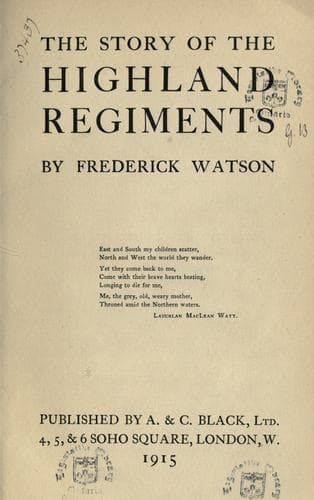
The Story of the Highland RegimentsWatson, Frederick
History
The Story of the Highland Regiments
Watson, Frederick
Great Britain. Army
Only a military genius could have undertaken a march without
communication lines, without heavy baggage, and with a hostile army at
the end of it. The prospect was not favourable. They were faced by three
hundred miles of the enemy’s country, the inhabitants of which would be
only too ready to fall upon them should an opportunity present itself,
and disaster would almost surely turn to annihilation. It would take too
long to deal with that eventful march, and there was little of actual
conflict throughout. On the 26th of August there was a sharp engagement,
the Afghans being thrown back; on the 31st the British came in sight of
Kandahar, where the Afghan leader was strongly posted. They had arrived
just in time. To the beleaguered garrison they were like an army dropped
from heaven.
On September 1 the action began, and the Seaforths and Gordons were sent
forward to expel the enemy from the village in which they were
entrenched. A fierce hand-to-hand engagement ensued, and facing the
thousands of the enemy Major White shouted to the 92nd: “Highlanders,
will you follow me?” “Joyfully and with alacrity the Highlanders
responded to the call of their favourite leader, and without pausing to
recover breath, drove the enemy from their entrenchments at the point of
the bayonet.” This was the heaviest piece of hard fighting, and shortly
after the enemy wavered and finally broke, being quickly dispersed by
the cavalry. An undisciplined army can seldom retire in good order; once
broken it is instantly confused, and in a few minutes the Afghan troops
were streaming away towards the hills. Roberts, worn out by fever and
the anxieties and fatigues of the last few weeks, did not spare himself
during that critical day, and when it was over he thanked each regiment
personally for their services. Right well had the Highlanders supported
him. He had left India for a country seething with revolution, and had
carried the Peiwar Kotal. There had followed the murder of Cavagnari,
the quick descent upon Kabul, those anxious days when the British forces
were besieged outside the city, victory only to be followed by the
memorable march to Kandahar, and, last of all, after the frightful
fatigues and endurance, this decisive action.
Roberts, in addressing the troops, reminded them of the glory they had
won. “You beat them at Kabul,” he said, “and you have beaten them at
Kandahar, and now as you are about to leave the country you may be
assured that the very last troops the Afghans ever want to meet in the
field are Scottish Highlanders and Goorkhas.”
[Illustration: THE SEAFORTHS AT CANDAHAR]
Public-domain text, read in full here on John Shaqi.
Reviews
Reviews
No reviews yet
Be the first to share your thoughts on this work.
Elsewhere in the archive
Join the Discussion
Join the discussion
Sign in to leave a comment or review.
Sign InorCreate an account