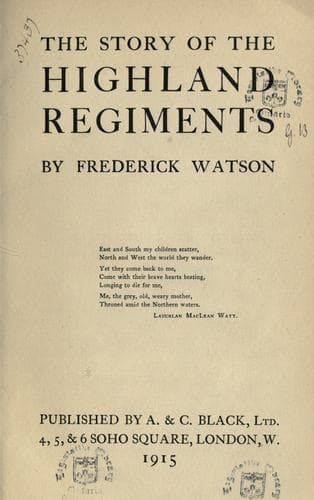
The Story of the Highland RegimentsWatson, Frederick
History
The Story of the Highland Regiments
Watson, Frederick
Great Britain. Army
It would take too long to deal at all circumspectly with the history of
South Africa. It was the Portuguese who originally discovered the Cape
of Good Hope, and for long years they were the controllers of the sea
and of Africa. Many years later other peoples began to colonise in
far-away lands, and Sir Francis Drake ran across the Cape, but as yet
there was no interest in the place from a commercial point of view; the
coast was merely used as a suitable stopping-place. Later on the
Dutch—who were a great sea people then—founded a colony where Cape Town
now stands. The French soon followed them, particularly the Huguenots,
who had fled from their own country and were glad to settle in Africa.
Last of all, the British became very anxious to found a settlement, and
in 1795 Cape Colony was added to the British Empire and the rule of the
Dutch was ended. The Dutch, who have always proved a courageous and
obstinate people, never ready to admit the superiority of anybody else,
in due course made their way elsewhere, preferring hardship to
dependence.
After the wars of Napoleon the other Powers in Europe recognised that
the British were supreme in South Africa, for which acknowledgment the
Government paid Holland a large sum of money. From this time onwards
troubles came at intervals from the Kaffir wars to the Zulu rising, from
Majuba to that greatest of all campaigns in South Africa—the Great Boer
War. From the beginning there were difficulties between the natives and
the Boers, the Kaffir siding now with the English and now with the
Boers, but usually against the latter. In the Kaffir campaigns the
Highlanders took part, but they are not of sufficient importance to
demand our attention.
There is one expedition, however, that has a memorable place in our
history. Some men of the 2nd Battalion of the Black Watch, the 91st
Argyllshire Highlanders, and the Highland Light Infantry were, in 1852,
shipped for South Africa to take part in the campaign against the
Kaffirs. They sailed upon the _Birkenhead_, and one dark night the ship
went to pieces at a place called Danger Point. So swift and sudden was
the shock that only a certain number of the boats could be lowered, and
had they all been used there was quite an inadequate number for both the
troops and the passengers. In perfect order the soldiers formed up in
companies, and the women and children were lowered over the side. The
horses were loosed and given a last chance for their lives. Then the
boats put off and the _Birkenhead_ was left to her fate. As the dawn was
breaking, with those silent figures as steady as on parade, the
_Birkenhead_ disappeared, and four hundred British soldiers went to
their death. That memorable scene has never been forgotten, and should
be recalled as one of the most honourable and moving incidents in the
history of the Highland regiments.
Public-domain text, read in full here on John Shaqi.
Reviews
Reviews
No reviews yet
Be the first to share your thoughts on this work.
Elsewhere in the archive
Join the Discussion
Join the discussion
Sign in to leave a comment or review.
Sign InorCreate an account