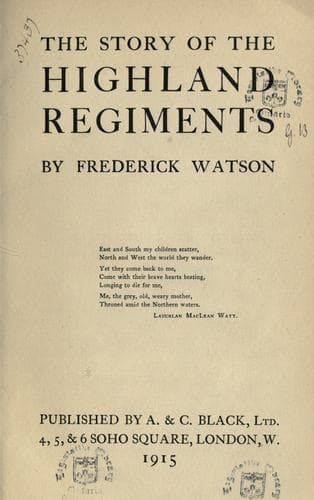
The Story of the Highland RegimentsWatson, Frederick
History
The Story of the Highland Regiments
Watson, Frederick
Great Britain. Army
Subsequent to the melancholy end of the _Birkenhead_, the Boers had made
their Great Trek, and the trouble with Dingaan, the Zulu chief, had
resulted in the massacre of their comrades.
With the discovery of gold the whole aspect of South Africa changed. The
country was suddenly inundated with all the riff-raff of Europe. The
“gold rush” wrought more harm than can ever be fully estimated. Strife
and trouble arose on every side. The Boers, who perpetually tyrannised
over the natives, also attempted to tyrannise over the British. At last,
on the 12th of April 1877, the South African Republic was taken over by
the English, and the Union Jack run up at Pretoria. Although the Boers
were very much aggrieved, they were quite unable to protect their rights
in the matter, as the country was full of British troops.
A Zulu war broke out under Cetewayo, in which the Transvaal Boers would
take no part, leaving the British to fend for themselves as best they
could. Events followed hard upon each other. The terrible disaster of
Isandlwana, where the British forces were cut off and suffered a loss of
800 men, sent a thrill through the whole of South Africa. Within a few
hours there followed the heroic defence of Rorke’s Drift, when a handful
of men kept 3000 Zulus at arm’s length for many hours. In 1879 the 91st
Highlanders left for Zululand, to take their share in the defeat of the
Zulus at the battle of Ulundi and the capture of Cetewayo.
In the meantime the dissatisfaction of the Boers had in no way
diminished. Desiring to regain their freedom, they made preparations for
doing so. They elected Kruger, Joubert, and Pretorius as their leaders,
and, on the 16th of December 1880, raised the flag of the Republic at
Heidelburg, their new capital. War was declared, and in January 1881 the
British suffered a reverse at Laing’s Nek, where they remained strongly
posted. Laing’s Nek was very close to a kopje that has passed into our
history as Majuba Hill.
We know a great deal more about the Boers now than we did then. We did
not realise at that time that they were a clever and courageous foe,
linking their intimate knowledge of the country with a sure and deadly
marksmanship. The British troops in South Africa were quite inadequate
in numbers to deal with such a situation. The 92nd Gordon Highlanders,
with their famous march to Kandahar still vivid in the public mind, were
hurried to reinforce the troops under General Sir George Colley at
Prospect Hill.
Public-domain text, read in full here on John Shaqi.
Reviews
Reviews
No reviews yet
Be the first to share your thoughts on this work.
Elsewhere in the archive
Join the Discussion
Join the discussion
Sign in to leave a comment or review.
Sign InorCreate an account