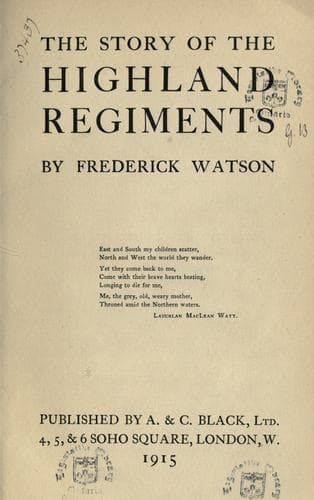
The Story of the Highland RegimentsWatson, Frederick
History
The Story of the Highland Regiments
Watson, Frederick
Great Britain. Army
To-day, when the long conspiracy of Prussia is admitted by the most
unsuspicious person, it can be recalled that, without question, the Boer
Government was in touch with Germany, and that not only cases of rifles
passed into Pretoria and Johannesburg, but that Krupp guns, outranging
our own artillery, were shortly to create the first of many surprises in
that surprising war. The sympathies of Europe were entirely with the
Boers, and, doubtless, Kruger had been advised from Berlin. Many Germans
took part in the campaign, and it was in certain measure to their expert
knowledge that the Boer artillery was so well manned. Beyond that the
Boers could fully hold their own. Botha, Joubert, and De Wet were in
their several capacities brilliant strategists and resourceful leaders.
The burghers were well armed, well mounted, exceedingly courageous, and
inspired by the deepest hatred for the British. The British, on the
other hand, were very ignorant regarding the Boer, greatly
under-estimated the numbers they could put in the field, had no expert
knowledge regarding the country or manner of the fighting there, and
could not persuade themselves that this was anything but a kind of
punitive expedition. By this time, with so many campaigns behind us,
some judgment can be formed upon the British Army, not only the Highland
regiments with whom we have dealt in particular, but those English Line
regiments and cavalry, whose prestige and courage have won a hundred
victories. Yet were these to suffer amazing disasters in South Africa.
The war was indeed to prove the graveyard of many hopes and many
reputations. Looking back at it now, after the interval of many years,
and when the greatest war has shown that the British Army is as
invincible as ever it was, we can only come to the conclusion that the
generalship in South Africa had for a season fallen altogether into
decay. The days of the Crimea and the Mutiny were long past; Roberts and
Wolseley were old men; Kitchener, the most competent organiser of the
younger generation, was still engaged with his great work in Egypt,
while a kind of dry-rot seems to have come over the generation that lay
between. The ultimate good of the South African War was that it cut this
dry-rot clean away; but the story of the war is one of great courage and
endurance struggling against the grossest incompetence.
Public-domain text, read in full here on John Shaqi.
Reviews
Reviews
No reviews yet
Be the first to share your thoughts on this work.
Elsewhere in the archive
Join the Discussion
Join the discussion
Sign in to leave a comment or review.
Sign InorCreate an account