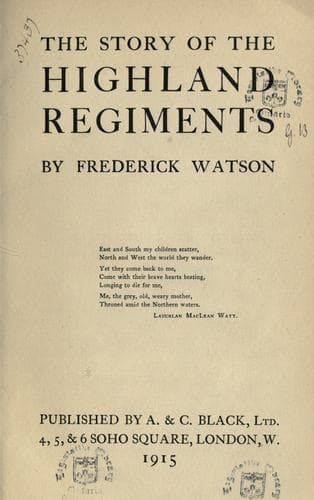
The Story of the Highland RegimentsWatson, Frederick
History
The Story of the Highland Regiments
Watson, Frederick
Great Britain. Army
The Boer Government kept the negotiations running until the falling of
the rain. With the rain the grass sprouted, the veldt was no longer like
a desert, and the days for campaigning were nigh. For many months Kruger
had been preparing for the conflict, while the British Government were
so deep in the political negotiations that they thought of nothing else.
The Boers could place 50,000 burghers, together with their heavy
artillery, in the field, while the British forces in South Africa were a
mere handful. Troops were despatched from India, including the 2nd
Gordon Highlanders, and these arrived at the end of September, bringing
the number of the British army in South Africa to 22,000.
On October 9, 1899, President Kruger issued his ultimatum, and within
forty-eight hours the Boer War had commenced. On October 12 the Boer
forces were on the march, 12,000 of them, with two batteries of eight
Krupp guns each, setting out from the north. From the Transvaal came
another commando accompanied by a number of Germans, armed with heavy
guns, and led by Joubert.
The British forces under the command of Sir George White and General
Penn Symons were concentrated at Ladysmith. This position was not a
strong one, and should really have been vacated, but it was quite
unsuspected that the Boer artillery was as powerful as to include 6-inch
Creusot guns. To Ladysmith came the Gordon Highlanders, who eventually
were to undergo the famous siege under their old officer. Some 4000
Britishers there were to meet the advancing Boers, who came “winding in
and out between the hills as far as eye could reach, the long black
string of horsemen stretched like an enormous serpent, with head and
tail lost in space.” In this manner the Boers entered Natal, and on the
12th of October came into touch with the British under General Penn
Symons. General Symons was a man of the greatest courage, and with the
utmost confidence and pride in his men. He awaited the arrival of the
Boers at Talana Hill, where, with the breaking of the dawn the black
figures of the enemy were first seen against the sky-line, and the
opening action of the long war commenced.
It was evident at once that the Boer artillery would make our position
untenable, and while our guns were endeavouring to gain a mastery over
those of the enemy, the infantry were sent up the front of the hill
under a very severe fire. General Symons was one of the first to fall.
To the last he encouraged his men, and throughout he had refused to take
the smallest care for his own safety.
This first conflict, which does not really concern us in this book, was
of no strategic value, and resulted in a heavy loss of men, though it
was in a sense a success, since the Boers were driven back from Talana
Hill. But it was the first indication that in a country like South
Africa the storming of one hill in a land of hills without any definite
strategic gain is simply bad generalship.
Public-domain text, read in full here on John Shaqi.
Reviews
Reviews
No reviews yet
Be the first to share your thoughts on this work.
Elsewhere in the archive
Join the Discussion
Join the discussion
Sign in to leave a comment or review.
Sign InorCreate an account