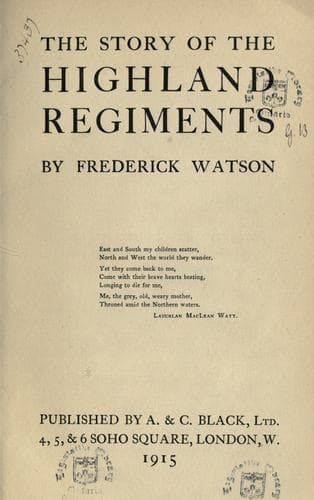
The Story of the Highland RegimentsWatson, Frederick
History
The Story of the Highland Regiments
Watson, Frederick
Great Britain. Army
Next day the Gordons returned to Ladysmith, where they were to
experience a four months’ siege.
Things moved quickly after this. On October 30 was the battle of
Nicholson’s Nek; on November 2 the last train left Ladysmith. Leaving
for a while the battalion of the Gordons to take their part in the
defence of Ladysmith, we will follow the Highland Brigade in their
advance upon Kimberley.
The opening of the war caused the greatest gratification to all
well-wishers of the enemy and a certain amount of despondency at home.
On the Continent there was the wildest delight that the Boer army was
carrying everything before them. Few nations, apart from America, Italy,
Denmark, and Greece, were able to conceal their elation that at last
England was likely to pass through her hour of bitter humiliation. After
a fortnight, in which five actions had taken place, we had lost a
quarter of Natal, a great stretch of railway, and saw our troops
besieged or on the eve of being besieged in Ladysmith, Kimberley, and
Mafeking. The situation could not be regarded as anything but critical.
At the same time reinforcements were being hurried out, and should these
various positions resist the Boer attacks there was no reason to suppose
that the ultimate victory was far off. On November 12 Lord Methuen had
reached the Orange River, and, accompanied by a well-equipped
force—though not a large one in number—he set out towards Kimberley,
where he found the Boers in possession of Belmont. The first action has
been described by Sir Arthur Conan Doyle as “an Alma on a small scale.”
The British troops took the hill by storm, driving the enemy from their
position at the point of the bayonet. But the unfortunate culmination to
the majority of these early actions was that the Boers bolted to their
ponies and galloped away, and owing to our lack of cavalry it was never
possible to turn a retreat into a rout. Lord Methuen repeated this
success two days later at Graspan, and on the 28th fought the battle of
Modder River, in which the Argyll and Sutherland Highlanders arrived in
time to take a part. Having driven the Boer before him on two occasions
within four days, Lord Methuen was under the impression that the farmers
had lost heart and would no longer put up a formidable resistance.
On the 28th began the advance on Modder River, upon whose banks General
Cronje was entrenched. Cronje was a man of considerable strength of
character, a skilful general after the Boer tactics, trusted implicitly
by his men, and in command of a strong and formidable commando. So far
the British had met the enemy entirely in hill country; it had become a
kind of dream amongst the British soldiers that if they could only catch
the Boer in a plain the effect of discipline and bravery would teach the
enemy a severe lesson. There was a certain amount of truth in this
belief, and when the Boers did eventually come in sharp contact with the
Lancers it was a bitter enough experience for them.
Public-domain text, read in full here on John Shaqi.
Reviews
Reviews
No reviews yet
Be the first to share your thoughts on this work.
Elsewhere in the archive
Join the Discussion
Join the discussion
Sign in to leave a comment or review.
Sign InorCreate an account