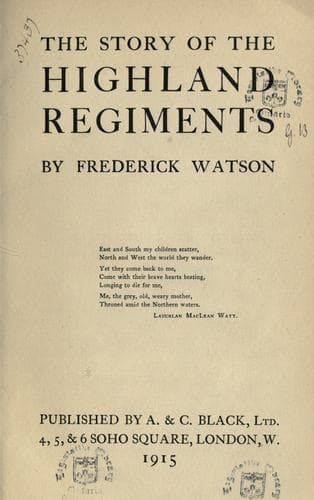
The Story of the Highland RegimentsWatson, Frederick
History
The Story of the Highland Regiments
Watson, Frederick
Great Britain. Army
Unhappily no precautions appear to have been taken to ascertain either
the strength of the enemy’s position or the best mode of attack. For
some reason or another, probably owing to an under-estimation of
Cronje’s position, the men were not even permitted to breakfast before
the march began, and so on a beautiful morning they set out towards the
undulating plain that lay upon the other side of the river.
Cronje had laid his plans with the utmost care and assurance, placing
his men on both sides of the river, entrenching them upon the sloping
ground, and concealing his artillery. The question has been raised—and
Sir Arthur Conan Doyle raised it again—Why the river should have been
crossed at that particular point; also why the British forces should
have been led over an open plain without any attempt at reconnaissance?
Such problems as these, however, might be multiplied to little purpose
throughout the earlier part of the South African campaign. Perhaps the
briefest answer to them would be that it was just because of such
incidents as these that the country was eventually to plead with its
oldest soldier to take over the command. Now that we have tested the
lessons that South Africa taught us, the humiliation has passed into
thankfulness that they came in time.
Cronje simply waited until the British were within range of his fire,
and then very suddenly opened a tornado of bullet and shell fire at a
range of seven hundred and fifty yards. One moment, and in front of them
had lain an apparently peaceful landscape, a few houses and farms
sleeping under the morning sun; the next, and the whole horizon was
blazing with death. It was fatal to advance; the cavalry could do
nothing, while the infantry were dependent upon the guns to gain the
superiority. At this critical moment one of the most dramatic incidents
in the war occurred. Out of the unknown, with staggering horses and guns
caked with mud, lumbered up the 62nd Field Battery, which had covered
thirty-two miles in less than twenty-four hours. It was a providential
piece of good fortune.
Throughout the long day the infantry lay under the broiling sun, just as
the remnants of the Highland Brigade were to endure it not very long
after. The artillery engagement wore on, the heat passed, and as night
came the British were gaining the advantage. All day they had been
without food. At last, in the late afternoon, the North Lancashires
managed to get across the river and take up a position on the extreme
left, where they were joined by the Coldstreams and the Argyll and
Sutherlands. The action was turning against the Boers. With this
desperate little force on their flank, and the artillery shattering
their guns on the front, they took advantage of the night to evacuate
their trenches and retreat. It had indeed been a costly action, and
might have been a humiliating defeat. What perhaps it was more than
anything else was a proof of British bravery under the most dismal
conditions.
Public-domain text, read in full here on John Shaqi.
Reviews
Reviews
No reviews yet
Be the first to share your thoughts on this work.
Elsewhere in the archive
Join the Discussion
Join the discussion
Sign in to leave a comment or review.
Sign InorCreate an account