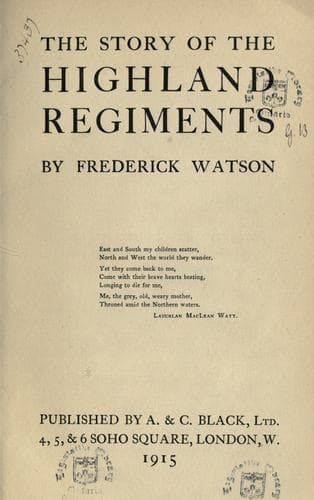
The Story of the Highland RegimentsWatson, Frederick
History
The Story of the Highland Regiments
Watson, Frederick
Great Britain. Army
According to F. G. Tait the first orders that emerged from the chaos and
noise and the groans of the wounded were those of, ‘Lie down, fix
bayonets, and prepare to charge.’ This, unhappily, led very little
farther. Tait writes as follows: “We got along a hundred yards or so
when we got into the dreadful flanking as well as frontal firing, and
lost very heavily. I could now see that the enemy were in trenches about
200-250 yards off. We managed to get 50 yards nearer, losing heavily all
the time, and there we lay down (what was left of the lot with me) and
began firing. I was about 15 or 20 yards in front, and had just got up
to get back in line when I got a bullet through my left thigh. I was
able to turn over on my stomach and fire at the Boers. A quarter of an
hour later it was quite light, and then we began to get it properly. The
men on each side of me were hit straight away, and in a few minutes very
few were left unhit. It was quite impossible for any ambulance or doctor
to advance, so all our wounded lay within 200 yards or so of the Boer
trenches all day in a broiling sun, being shot at whenever they moved
until seven o’clock at night, most of them without a drop of water.”
And yet out of this dismal event, despite their terrible position, the
Highland Brigade did not lose their prestige. Trapped, bewildered,
unable either to advance or retreat, they held their ground and died
without fear. Many, indeed, perceiving that no officers were left to
lead them, advanced on their own initiative through the hail of fire,
and were discovered in the morning suspended on the barbed wire before
the Boer trenches. A section of the Black Watch, it is recorded, refused
to retire, and entrenching themselves as far as they could, carried on
the combat throughout the long terrible day, until when night fell there
was not one single survivor left. All through that desperate day the
Highlanders lay exposed to the Boer fire, refusing to surrender, without
food or water, wounded and unwounded together, awaiting the support from
the artillery and the reserves, which was so difficult to give. It has
been recorded of the Argyll and Sutherlands that their claim to the
pledge, “We die, but we do not surrender,” was most nobly earned that
day. At Magersfontein the regiment that had provided the ‘thin red line’
at Balaclava remained steady under the terrific fire, and it was owing
in a large degree to the 93rd and to the Coldstream Guards that their
unfortunate comrades, who had led the advance and suffered more
terribly, were enabled to hold out during the day.
Public-domain text, read in full here on John Shaqi.
Reviews
Reviews
No reviews yet
Be the first to share your thoughts on this work.
Elsewhere in the archive
Join the Discussion
Join the discussion
Sign in to leave a comment or review.
Sign InorCreate an account