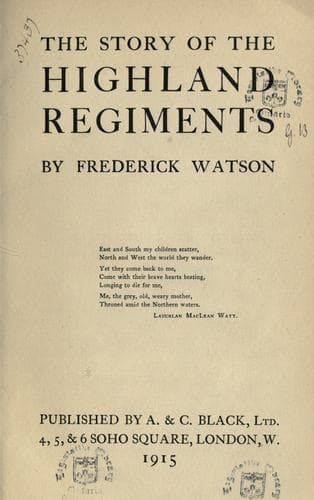
The Story of the Highland RegimentsWatson, Frederick
History
The Story of the Highland Regiments
Watson, Frederick
Great Britain. Army
To return to the actual conflict. It is stated that within a few moments
of the opening of the Boer fire at least 600 men were out of action.
Less courageous or disciplined soldiers would have broken and scattered
wildly to the rear, and none could have called them cowards; but the
Highland Brigade, assembling as far as was possible within their own
units, had by the break of day made some attempt at following up the
belated attack. Unfortunately the Boers were so securely entrenched that
it was a very one-sided affair. The rising sun brought the Horse
Artillery up at the gallop, and under cover of their fire the Highland
Brigade were enabled to get some respite from the deadly Boer
marksmanship. As day advanced reinforcements were hurried up, the
Gordons coming with the 1st and 2nd Battalions of the Coldstreams, and
the gallant Yorkshire Light Infantry to protect the flank. In the
afternoon the Highland Brigade—who had tasted neither food nor water for
twenty-four hours—made a pitiful effort to charge the Boer position. The
fire that was opened upon them was, at so short a range, almost
annihilating. It was inevitable that they must remain out of action
until they could fall back and reassemble. The Gordons, who came fresh
into action, did what was possible to distract the Boer fire from their
unhappy comrades, and when the evening came the merciful darkness
enabled the wreckage of the Highland Brigade to creep back to the rear.
The bitterest day in the story of the Highland regiments was, at last,
at an end. The disaster at Magersfontein brought with it a loss of
nearly 1000 men; out of the Highland Brigade 57 officers had fallen, and
in the Black Watch alone 19 officers and over 300 men. Never in the
annals of that regiment had there been such a loss since the action at
Ticonderoga in 1757.
In his report of the action, Lord Methuen sums it up as follows: “The
attack failed. The inclement weather was against success. The men in the
Highland Brigade were ready enough to rally, but the paucity of officers
and non-commissioned officers rendered this no easy matter. I attach no
blame to this splendid brigade. Nothing could exceed the conduct of the
troops from the time of the failure of the attack at daybreak. There was
not the slightest confusion, though the fight was carried on under as
hard conditions as one can imagine, for the men had been on the move
from midnight, and were suffering terribly from thirst.”
The next morning the Boers awaited a British attack, which never came.
It was evident from the disaster that had overtaken the Highland Brigade
that it would be almost impossible to storm the Boer position by a
frontal assault. Lord Methuen, feeling that he could not carry out a
flanking movement without reinforcements, decided he would rest his
troops, and postpone for the present the advance on Kimberley.
Footnote 11:
_F. G. Tait._ By J. L. Low.
Public-domain text, read in full here on John Shaqi.
Reviews
Reviews
No reviews yet
Be the first to share your thoughts on this work.
Elsewhere in the archive
Join the Discussion
Join the discussion
Sign in to leave a comment or review.
Sign InorCreate an account