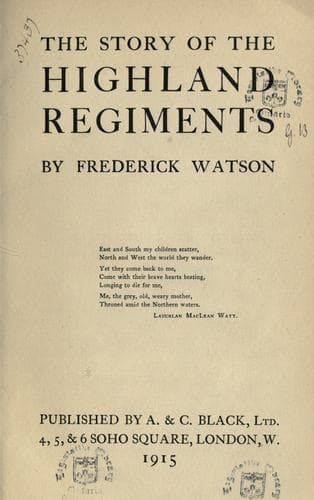
The Story of the Highland RegimentsWatson, Frederick
History
The Story of the Highland Regiments
Watson, Frederick
Great Britain. Army
Gatacre fell back after the action, and was shortly reinforced, but the
incident had in no way improved matters for the prestige of the British
arms. Within a week Methuen had suffered a crushing reverse at
Magersfontein while Gatacre had been again beaten.
Fortunately by this time great numbers of troops were arriving in South
Africa, and soon after Sir Redvers Buller prepared for the crossing of
the Tugela River. On Friday, December 15, he advanced from Chieveley
Camp to storm the Boer position. It was the first step towards
Ladysmith. As none of the Highland regiments took part in this action,
it is merely necessary to record that the battle of Colenso took place,
and despite the heroism of the British soldiers, and in particular the
Irish Brigade, the action was lost, and our troops, after a loss of 600,
fell back on Chieveley Camp.
The first advance to the relief of Ladysmith had been severely and
ignominiously checked.
The Christmas of 1899 was as black as any through which our nation has
passed. The repeated defeats of the British forces flung a gloom over
the country that for a moment almost paralysed it. More and more troops
had been despatched to South Africa, and numbers only seemed to magnify
our disasters. At such a moment Britain turned to her sons in this
country and throughout the Empire.
But it was necessary to do more than raise new armies: the whole country
required reassurance, and the name of one man instantly rose before the
public mind. When Lord Roberts was asked to take supreme command in
South Africa, with Kitchener as his Chief of Staff, he accepted with the
same readiness that Sir Colin Campbell displayed at the time of the
Indian Mutiny. “It is God’s will,” said Roberts, now heartbroken at the
death of his son, and two days before Christmas he left London for the
front.
His very name was half the battle, for, to recall the familiar lines:
There is something that’s audacious
In the very name of ‘Bobs,’
There’s a dare and dash about it
Makes you sort of want to shout it,
So that all the world can hear it
As you cheer.
On January 10, 1900, he landed at Cape Town, and appreciated at once the
extreme gravity of the situation. The successes of the Boers were
encouraging signs of revolt amongst the Cape Colonists, and to crush
these symptoms at once Roberts set out towards the Orange Free State,
anxious at the same time to distract the pressure upon Kimberley and
Ladysmith. But there were many other things to do. In such a country as
South Africa great numbers of mounted troops were a necessity. No
attempt had been made so far to work upon the material that was already
to hand. Regiments were formed of South African colonists, and mounted
forces such as the Yeomanry and the Australian and Canadian Horse were
to prove one of the most potent influences in the later stages of the
campaign.
Public-domain text, read in full here on John Shaqi.
Reviews
Reviews
No reviews yet
Be the first to share your thoughts on this work.
Elsewhere in the archive
Join the Discussion
Join the discussion
Sign in to leave a comment or review.
Sign InorCreate an account