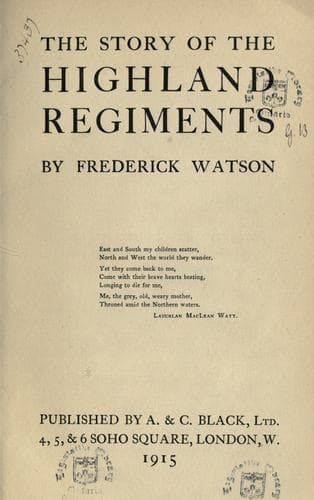
The Story of the Highland RegimentsWatson, Frederick
History
The Story of the Highland Regiments
Watson, Frederick
Great Britain. Army
In the meantime there was continued bad news from the seat of war. Again
Buller had attempted to cross the Tugela River, and had met with utter
defeat. The forlorn capture of Spion Kop, with a loss of men amounting
to forty per cent, had only proved a futile engagement and a barren
victory.
Buller, who was courageous as a lion, admitted that his heart failed him
after Spion Kop, and that he feared the relief of Ladysmith had become
an impossibility. But Roberts telegraphed to him that whatever the cost
might be, Ladysmith must be relieved. In the meantime Roberts set out
upon the road to Bloemfontein with the hope of relieving Kimberley by
the end of February. On February 8 he reached Methuen’s camp on the
Modder River, and knowing so well how sore the Highland Brigade must
feel over the disaster at Magersfontein, he made them a little speech
stating that he had never campaigned without Highlanders, and hoped he
would never do so, and it was the Highlanders in India and Afghanistan
who had brought him his success. He then wired to Kimberley the three
words that were to mean so much, “We are coming.”
It was all like a rushing of clean wind in a parched land. Now for the
first time the Boers found themselves baffled as to the intentions and
plans of a British leader. They had hitherto taken it for granted—and
rightly so—that they would be forewarned of every move that was to take
place, and had acted accordingly. Lord Roberts gave them the impression
that Bloemfontein was his objective. Instead, on February 12 he
instructed General French to make a dash on Kimberley, while he would
follow with the infantry. French, the only general to make his
reputation in South Africa, and almost the only one who did not lose it,
set out with his cavalry, made his way round the Boer position, and
pierced the Boer lines. Then, hastening on, he broke through the enemy,
and that same evening entered Kimberley.
The genius of French was even more apparent at Koodoostrand Drift, where
he cut off Cronje’s retreat toward Bloemfontein. It was a piece of
military daring as great as the sudden appearance of Montrose at
Inverlochy, or Jackson at Manasses Junction. Speedily Cronje entrenched
his men, but the arrival of the infantry rendered his ultimate surrender
inevitable.
Public-domain text, read in full here on John Shaqi.
Reviews
Reviews
No reviews yet
Be the first to share your thoughts on this work.
Elsewhere in the archive
Join the Discussion
Join the discussion
Sign in to leave a comment or review.
Sign InorCreate an account