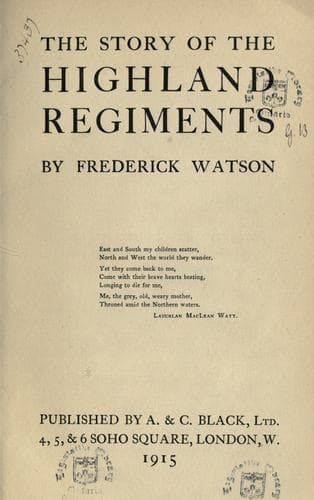
The Story of the Highland RegimentsWatson, Frederick
History
The Story of the Highland Regiments
Watson, Frederick
Great Britain. Army
From November 3 onwards the progress of the siege was marked by daily
fighting and increasingly short rations. Each regiment was given a
certain section of the circumference to defend. Time dragged on, until
by the beginning of December, news came that Buller had reached Frere
Camp, while, in the far distance, could be heard the booming of his
guns. Later, it was borne in upon the garrison that the British force
must have suffered a reverse, and that relief was probably farther away
than ever.
Enteric and typhoid were thinning out the ranks, food was running short,
and things began to look very hopeless when, in the first gleam of light
on January 6, 1900, the enemy launched a formidable attack. The defeat
of Buller had enabled the Boers to send reinforcements from Colenso.
They were full of confidence, and at the initial assault carried
everything before them. It very soon became a case of hand-to-hand
fighting, in which the Gordons were called up with Ian Hamilton in
command. The Boers were determined to capture Ladysmith, knowing the
great moral effect that would be produced following upon their victory
at Colenso. The Manchesters, nearly overcome at Caesar’s Camp, put up a
magnificent resistance, until the Gordons came up. It was in this
advance that Colonel Dick-Cunyngham was killed.
The British were determined that their positions should never be taken
by the enemy while they survived, and in one place defended by sixteen
of the Manchesters, at the end of the day fourteen lay killed, the
remaining two out of action. Throughout that day this fierce fighting
continued, until at last the Devons, with the Gordons and the Rifles,
cleared the ridge of the enemy. It had been touch and go, but at the
last extremity the Boers could not face the gleaming steel of the
bayonet, and a few minutes later were falling back from their trenches.
A fight lasting for twenty-six hours was over at last. “But the end,”
says Sir Arthur Conan Doyle, “was not yet. The Boer had taken a risk
over this venture, and now he had to pay the stakes. Down the hill he
passed, crouching, darting, but the spruits behind him were turned into
swirling streams, and as he hesitated for an instant upon the brink, the
relentless sleet of bullets came from behind. Many were swept away down
the gorges and into the Klip River, never again to be accounted for in
the lists of their field cornet. The majority splashed through, found
their horses in their shelter, and galloped off across the great Bulwana
Plain, as fairly beaten in as fair a fight as ever brave men were yet.”
This was the final attempt to take Ladysmith by storm, and it cost the
British 13 officers and 135 men killed, with 28 officers and 244 men
wounded.
Public-domain text, read in full here on John Shaqi.
Reviews
Reviews
No reviews yet
Be the first to share your thoughts on this work.
Elsewhere in the archive
Join the Discussion
Join the discussion
Sign in to leave a comment or review.
Sign InorCreate an account