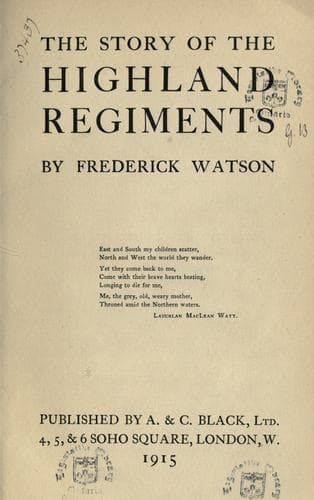
The Story of the Highland RegimentsWatson, Frederick
History
The Story of the Highland Regiments
Watson, Frederick
Great Britain. Army
Inside the laager Cronje, despite the bitter recriminations of the
Boers, did his best to put up a stout resistance, while outside our
troops crept nearer night by night, until on February 27—the anniversary
of Majuba—the Gordon Highlanders, to whom such a task was naturally very
acceptable, advanced upon the Boer trenches under a heavy fire, and won
a position controlling the inside of the laager. Cronje, realising that
further resistance was impracticable, sent in a notice of his surrender
to Lord Roberts. The meeting of the Boer commander and the hero of
Kandahar must have been one of the most graphic incidents in the war. An
eye-witness has narrated: “Presently the body of horsemen came past the
hospital tents into the camp. A heavy bundle of a man was lumped atop of
a wretched bony little Boer pony. Was this the terrible Cronje? Was it
possible that this was the man who had held back the British army at
Magersfontein?... Lord Roberts stepped forward, saluted, shook hands,
and handed his fallen enemy a chair: ‘You have made a gallant defence,
sir; I am glad to meet so brave a foe,’ was his greeting.”
Thus within a brief fortnight Roberts had entirely altered the whole
aspect of the war. He had inflicted a heavy defeat upon the Boers,
relieved Kimberley, and captured Cronje, together with 4000 men. From
now onwards his swift advance, his unerring judgment, and the services
of his mounted troops not merely gave fresh heart to the Empire, but
broke the confidence of the enemy.
We must now return to Ladysmith. It was on October 30, 1899, after the
humiliating disaster at Nicholson’s Nek—a disaster that can be compared
to the surrender of the Duke of York’s troops in Flanders in the
eighteenth century, that Sir George White made what preparations he
could to defend the town of Ladysmith. On November 2 the last train had
left, and the long siege commenced.
White had some 10,000 men under his command, and although the Boer
commandos numbered a very large force, the defenders managed to give
throughout the siege of four months an exceedingly good account of
themselves. Ladysmith was a place of considerable military importance,
and it would have been a signal disaster if it had fallen into the Boer
hands with so large a number of men. At the same time it was a very
difficult position to hold, being commanded from every side by kopjes,
and lying, as it were, in a saucer. The Gordon Highlanders, who were the
only representatives of the Highland Brigade to serve in the siege, were
old comrades-in-arms to White. He had led them in the advance upon Kabul
and Kandahar. With him was Sir Ian Hamilton, who had been with the 92nd
at Majuba.
Public-domain text, read in full here on John Shaqi.
Reviews
Reviews
No reviews yet
Be the first to share your thoughts on this work.
Elsewhere in the archive
Join the Discussion
Join the discussion
Sign in to leave a comment or review.
Sign InorCreate an account