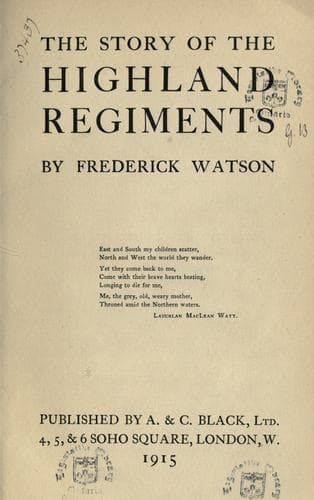
The Story of the Highland RegimentsWatson, Frederick
History
The Story of the Highland Regiments
Watson, Frederick
Great Britain. Army
The unconquerable British Infantry have never displayed the qualities of
dogged endurance so finely as in that eventful rearguard action. The
Germans could neither outflank, pierce, nor crush the thin khaki line.
It was the supreme test of a veteran regular army. It is of interest to
recall that, on his return from the march to Kandahar, Lord Roberts, at
the Mansion House, stated that he would never have undertaken the risk
of covering 300 miles of country unless he had been accompanied by
veteran troops. “The characteristics of young soldiers,” he said, “are
to win a winning game; to attack with dash where success seems probable;
or even to stand up to superior forces where courage has not been damped
by previous reverses and faith in their leader remains unimpaired. Under
such conditions they may even surpass their older comrades. But in times
of danger and panic, when the bugle sounds the Retire, when everything
seems to be going against us, and when danger can only be avoided by
order and presence of mind; then it is that the old soldier element
becomes of incalculable value; without it a commander would indeed be
badly off.”
[Illustration: THE ARGYLL AND SUTHERLANDS ENTERING BOULOGNE AUGUST 1914]
During the retreat from Mons the Highland regiments lost very heavily in
officers and men, and amongst them there fell the Master of Burleigh, a
very gallant and popular officer in the Argyll and Sutherlands. “He was
too brave for anything,” related a Highlander, “he simply wanted to be
at ’em, and at ’em he went. I don’t know where his sword was, but he
hadn’t it when I saw him—he had a rifle with the bayonet fixed, just
like the rest of us. I saw him at the time he was wounded, and he just
fought on gamely till he and his party of brave fellows were cut off and
surrounded.”
We learn that the Camerons were in close touch with the Black Watch at
Mons, and at one point in the retreat when the 42nd were in danger of
being surrounded, the 17th Battery R.F.A. and the Camerons staved off an
outflanking movement of the Germans.
The 1st battalion of the Gordons were practically annihilated in their
first battle. For long they had the melancholy reputation of being the
most badly hit regiment in the Army, until Neuve Chapelle and the losses
of the Cameronians and the Seaforths, while in the first week in
February 1915 the Black Watch fared no better.
Public-domain text, read in full here on John Shaqi.
Reviews
Reviews
No reviews yet
Be the first to share your thoughts on this work.
Elsewhere in the archive
Join the Discussion
Join the discussion
Sign in to leave a comment or review.
Sign InorCreate an account