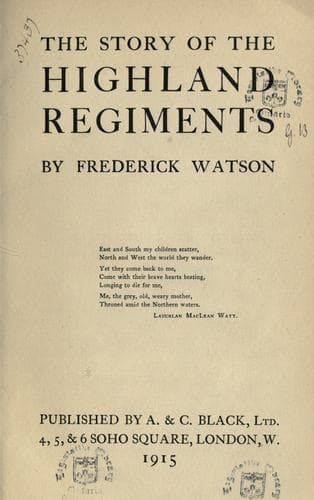
The Story of the Highland RegimentsWatson, Frederick
History
The Story of the Highland Regiments
Watson, Frederick
Great Britain. Army
The battle of the Aisne inflicted heavy casualties on the Highlanders,
particularly the Black Watch, losses which after the battle of the Marne
brought the following unforgettable tribute from Sir John French: “The
Black Watch—a name we know so well—have always played a distinguished
part in the battles of our country. You have many well-known honours on
your colours, of which you are naturally proud, but you will feel as
proud of the honours which will be added to your colours after this
campaign. At the battle of the Marne you distinguished yourselves. They
say that the Jaegers of the German Guard ceased to exist after that
battle. I expect they did. You have followed your officers, and stuck to
the line against treble your numbers in a manner deserving the highest
praise. I, as Commander-in-Chief of this Force, thank you, but that is a
small matter—your country thanks you and is proud of you. The Russians
have won great victories, but you, by holding back the Germans, have won
great victories as well, as if you had not done this the Russians could
not have achieved their successes. I am very glad of this opportunity of
addressing you, and thanking you personally for your splendid work.”
One member of the battalion has written: “We lost heavily in taking up
position, and the men were saddened by the loss of so many officers....
Then later, the men had to deplore the loss of their commanding officer,
Colonel Grant Duff—one of the bravest and best officers the regiment
ever had. He died bravely. He was hard pressed, and doing execution with
one of his men’s rifles when he fell with a mortal wound.”
The melancholy fate of one battalion of the Gordons has yet to be
revealed, but from various accounts there is little doubt that in the
confusion of the swift retreat, and the overwhelming force of the
Germans, the message for a withdrawal did not reach them, and acting up
to the gallantry of their records, they and their distinguished Colonel
remained at their posts until surrender was the only course left to
them.
The battles of the Marne and the Aisne were the turning of the scales
before the German retirement. On September 13 Colonel Bradford of the
Seaforths was killed. One account of his end runs: “It was in the battle
of the Aisne, when the Seaforths had taken up a position near a wood,
that the Germans began a heavy fire. The Colonel was standing with two
other officers surveying the field of operations, when he was struck by
a shell and killed instantly.”
Another affecting passage runs: “We laid him with two other officers to
rest on their field of honour, on a hill-side overlooking a valley of
the river. It was a sad but glorious moment for us to stand and hear the
padre tell us that they had not shrunk from their duty, and had fallen
for the sake of their comrades. The next day I found some Scotch
thistles growing close by, and I plucked the blooms to form a cross over
the dead chieftain’s grave.”
Public-domain text, read in full here on John Shaqi.
Reviews
Reviews
No reviews yet
Be the first to share your thoughts on this work.
Elsewhere in the archive
Join the Discussion
Join the discussion
Sign in to leave a comment or review.
Sign InorCreate an account