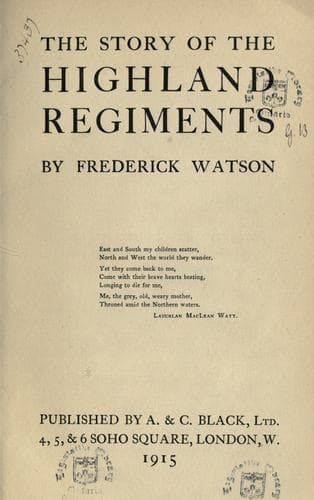
The Story of the Highland RegimentsWatson, Frederick
History
The Story of the Highland Regiments
Watson, Frederick
Great Britain. Army
Sir Arthur Conan Doyle has truly said that “from October 25 to the
second week in November Sir John French and Sir Douglas Haig were like
engineers holding up a dam of water visibly giving way.” The great
German advance towards Calais established the most critical situation of
the war, and the ultimate success of our troops at the battle of Ypres,
when 150,000 British and Indians withstood 600,000 Germans, will some
day be proclaimed as the most brilliant achievement in our military
history.
In the first great battle at Ypres the Highland regiments were supported
by their comrade battalions of the Territorials. In this desperate rush
for Calais, when the Germans came flocking onwards like ants upon the
side of a hill, when opposed to them was an army vastly inferior in
numbers, things looked desperate indeed. The headquarters of General
Haig were blown up, and when General French reached the British lines a
retirement of four miles had taken place. He motored from one spot to
another, propping up, as it were, this heroic handful of men. The
British fought doggedly, watching their regiments rent to tatters,
calling up every man, even the cooks, to take a hand. Cavalry and
infantry, officers and men fought till they could fight no more. But the
tide was turning, and when night fell upon the 31st of October the grand
attack was beaten off. Of the losses of our soldiers and our brave
Highlanders some estimate may be made by the casualties of individual
regiments, one of which entered the battle with 1100 men and came out
with only 73, and another which numbered 1350 returned only 300 strong.
On November 15 the Prussian Guard, the finest body of men in the German
army, advanced under the eyes of the Kaiser to wrench the road to Calais
from the British. They were met by the English Guards, by the
hard-fighting Highlanders, by the English fine regiments, by Irishmen,
Welshmen, and our gallant Indian soldiers—and they were held until their
dead lay eight deep.
These actions at Ypres were costly in casualties—50,000 out of 120,000;
they were beyond all price in glory and honour.
The coming of winter, and the construction of trenches, brought with it
a state of stalemate that was to last without a decisive offensive until
the spring of 1915.
During those long dreary months we were not idle. Our new armies were in
hard training, our war manufactories were making equipment, but
unfortunately not enough shells, and our Navy was carrying on its
imperishable vigil upon the sea, and under the sea, without which our
Empire would cease to exist and our Army would be cut off by twenty
miles of water.
The Highland regiments settled down with their customary fortitude to
the weary months of trench warfare, months that brought daily losses in
officers and men, bitter cold, and ceaseless rain, while overhead
screamed and broke the German shell fire.
Public-domain text, read in full here on John Shaqi.
Reviews
Reviews
No reviews yet
Be the first to share your thoughts on this work.
Elsewhere in the archive
Join the Discussion
Join the discussion
Sign in to leave a comment or review.
Sign InorCreate an account