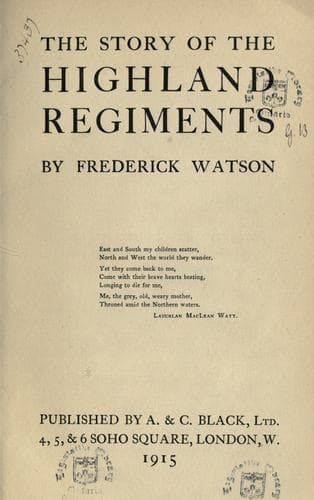
The Story of the Highland RegimentsWatson, Frederick
History
The Story of the Highland Regiments
Watson, Frederick
Great Britain. Army
Never have troops been called upon to endure such a prolonged strain. On
land and on sea, in patience and good temper, our soldiers and sailors
held on without a murmur.
Of the actual fighting there is little to tell, for little is known. The
monotony of trench warfare was broken by occasional frays and night
attacks. A Seaforth writes on October 20: “We were digging trenches when
we heard a volley of rifle fire come right over us, and we got the order
to stand to arms and advance. Their trenches were situated in a row on a
rise in a field, and we could not get our range on them. In a minute the
signal to charge went, and we all scrambled up the hill to get at them.
The first to get up was one company officer, and he was hit. We all
dived into their trenches at the point of their rifles, shooting and
stabbing, and then came the onslaught. Some of them were too terrified
to get out, whilst others rushed out and were shot down, and the
remainder sought refuge in a house.... About fifty surrendered. I am
proud to say that we were only one company. I shall never forget that
charge as long as I live. The General said, ‘Bravo, Seaforths! It was a
grand charge.’”
A Frenchman has recorded his impressions of a Highland regiment taking
part in an advance. “Resolutely,” he writes, “they crossed what had
seemed impossible ground. They seemed to do it, too, without sustaining
very much loss, and fixing bayonets, they made straight for the German
gunners. They charged to the shrill sound of the bagpipes. They charged
like heroes of Walter Scott, with their ribboned bonnets and their
dancers’ skirts. Neither ditch nor barbed wire could stop them. Their
dash carried them right into the midst of the Prussian batteries.
Shooting the gunners at their posts, they rendered the guns
unserviceable, and having completed their daring mission, prepared to
retire.”
The French _Nord de la France_ is no less emphatic in its praise. “The
British soldier,” it says, speaking of an advance of the Highlanders
under a murderous fire, “is wonderful. He is a slave to duty. For him to
retreat he must be ordered to do so, and these Scotsmen were prepared to
give their lives to the last man.”
Speaking of a charge in December a Gordon Highlander has written: “I
reckon it was one of the fiercest fights that the ‘Gay Gordons’ took
part in, and as usual the good old regiment covered itself with glory. A
certain General and officers who had witnessed the famous Dargai charge
told us it was ridiculous compared with that of December 14.”
From January 25 to February 7 the actions at Givenchy and La Bassée took
place, and were followed by a brief lull, with an outbreak of fighting
at Ypres upon February 14.
Public-domain text, read in full here on John Shaqi.
Reviews
Reviews
No reviews yet
Be the first to share your thoughts on this work.
Elsewhere in the archive
Join the Discussion
Join the discussion
Sign in to leave a comment or review.
Sign InorCreate an account