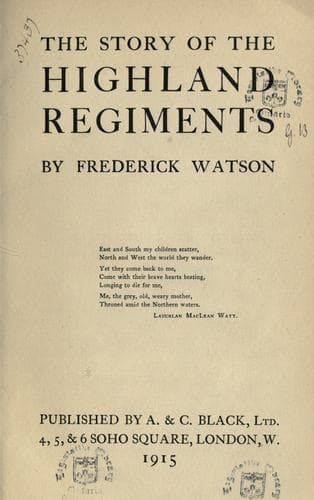
The Story of the Highland RegimentsWatson, Frederick
History
The Story of the Highland Regiments
Watson, Frederick
Great Britain. Army
On March 10 the operations that were to develop into the battle of Neuve
Chapelle and St. Eloi commenced. It was the beginning of the great
offensive, which, so long looked for, was to fail so dismally owing to
the need for shells, and the German use of poisonous gases. It resulted
in the taking of two miles of German trenches, and the killing and
capture of 8000 of the enemy. In this action our soldiers drove the
enemy from their trenches, and after heavy losses resisted all attempts
to evict them.
All through the preceding night our troops had marched to their
positions, and with the breaking of day our artillery began to bombard
the German trenches. A hundred heavy guns spoke with one prolonged roar,
the field guns joined in, the whole British artillery was concentrated
upon the enemy. No trenches could stand such a destructive fire.
Forty minutes later the advance began and the village of Neuve Chapelle
was carried at the point of the bayonet.
It was in the rush upon the trenches that the Middlesex, faced by
unbroken barbed wire, were mown down in scores and hundreds. Helplessly
they tore at the entanglement—in silence they died rather than retreat.
Following that came the attack upon the German position, and in this
advance were the 2nd Gordon Highlanders and their Territorial battalion
the 6th. It was in this action that Lieutenant-Colonel Maclean of the
6th Gordons lost his life. To a subaltern who went to his assistance he
said, “Thank you, and now, my boy, your place is not here. Go about your
duty.”
The battle of Neuve Chapelle was finely conceived, and more finely
carried out. Most unfortunately, owing to the lack of reserves at the
height of the engagement, the full force of the attack was spent too
soon.
The story of how the Canadians fought and died at the second battle of
Ypres upon April 22, and how the comrade regiment of the Royal
Highlanders brought immortal honour to the North, is a tale of four
days’ heroism against unnatural and horrible odds.
Mr. J. Huntley Skrine has written somewhere:
Sons in my gates of the West,
Where the long tides foam in the dark of the pine,
And the cornlands crowd to the dim sky-line,
And wide as the air are the meadows of kine,
What cheer from my gates of the West?
What indeed! Nothing less than death rather than defeat. Whatever the
Canadians might be, they were not veteran soldiers. The Canadian
Division numbered doctors, lawyers, farmers, with a sprinkling of men
who had seen service in the South African War. Let us see how they faced
the German onslaught.
Public-domain text, read in full here on John Shaqi.
Reviews
Reviews
No reviews yet
Be the first to share your thoughts on this work.
Elsewhere in the archive
Join the Discussion
Join the discussion
Sign in to leave a comment or review.
Sign InorCreate an account