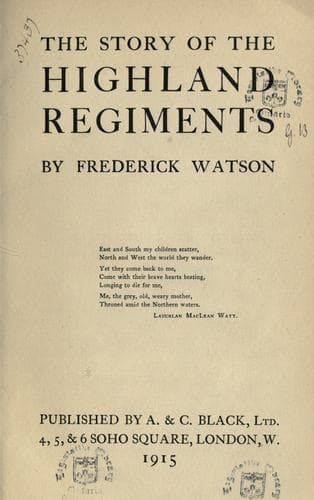
The Story of the Highland RegimentsWatson, Frederick
History
The Story of the Highland Regiments
Watson, Frederick
Great Britain. Army
The _Deutsche Tageszeitung_ says: “The British advanced with
extraordinary force. They had in action about a division, and called
upon them to advance in three lines. After the first line had been
thrown back with fearful losses, the second line could not advance. The
_élite_ regiment, the Scottish Black Watch, was called forward, and bled
to death without having obtained anything. Two men actually reached our
breastworks, and had to lie in front of them from five in the evening
until six the next morning before we could look after them.”
Between May and July there was no sustained activity upon the Western
Front, but on many other parts of the Allies’ vast campaign the
ceaseless struggle proceeded. Italy was pressing onwards towards the
Austrian line while Sir Ian Hamilton was endeavouring to retrieve the
initial blunder at the Dardanelles. Russia was fighting tooth and nail
her amazing rearguard action, retreating victoriously, relinquishing at
a terrible cost territory already stripped and barren. It was the
beginning of the great retreat. Warsaw fell upon August 5, and a month
later the Czar took over the supreme command, and the Grand Duke
Nicholas left for the Caucasus.
In July came the news of our first great British victory, a victory the
more welcome as it was won by General Botha, whose strategical skill and
courage we had learned to admire in the Boer War. Despite the plotting
of De Wet and Beyers, Kemp and Maritz, Botha had overcome disloyalty
amongst the dissatisfied burghers, and followed it up by the complete
rout of the Germans in South-West Africa.
With the month of August one year of bloodshed was reached, and looking
over the wide field of hostilities there were those who asked what had
been accomplished in return for precious lives lost upon a hundred
fields of strife. Our casualties numbered 330,000, while the loss of
life amongst our brave Allies had been enormous. Russia was no nearer
Berlin than at the commencement of the war, France was no nearer the
frontier of Belgium, England had not stormed the Dardanelles.
On the other hand, the Allied Armies were growing stronger, and the
German armies weaker; the scales were turning. Time was upon the side of
the Allies, and the greatest victory of the past year was won by no
array of arms, but by the sleepless vigilance of the British Navy. It
was a struggle between an invincible Army and an invincible Navy, and
unless some unforeseen catastrophe overwhelmed the Allied Armies the
issue lay in the hands of Great Britain.
To return to the Highland regiments, there were many individual acts of
heroism during those summer months that should be recorded.
On May 9 the Black Watch won two V.C.’s for magnificent bravery under
fire—Private John Lynn working a machine gun until he was overcome by
gas poisoning, to which he fell a victim, and Corporal John Bridley
leading a few Highlanders against the enemy’s trenches, and maintaining
his position.
Public-domain text, read in full here on John Shaqi.
Reviews
Reviews
No reviews yet
Be the first to share your thoughts on this work.
Elsewhere in the archive
Join the Discussion
Join the discussion
Sign in to leave a comment or review.
Sign InorCreate an account