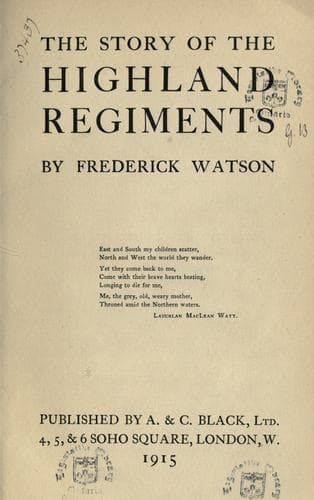
The Story of the Highland RegimentsWatson, Frederick
History
The Story of the Highland Regiments
Watson, Frederick
Great Britain. Army
Upon June 12 at Givenchy, Lance-Corporal William Angus of the Highland
Light Infantry won the V.C. for rescuing a wounded officer under heavy
fire, sustaining some forty wounds from bombs.
In the middle of June at Hooge, the Liverpool Scottish, a Territorial
battalion second to none, advanced against the German trenches,
supported by the H.A.C. The plan of attack was that the Scottish should
take the first line of German trenches, and leaving the H.A.C. to hold
them should advance upon the second line. Following the cannonade of our
guns, the Scottish leapt over the parapets and charged into the curtain
of smoke. The first trench was carried without a halt, the second fell
immediately after, and pausing to take a breath the battalion captured
the third after severe fighting, and faced the fourth. This, too, was
carried. What need for comment when words are blinded by achievement!
Many gallant men fell, including Captain Graham, the great amateur
golfer. Unhappily a sorrowful toll of lives must ever be the fruit of
bravery and self-sacrifice.
It is difficult where heroism has become a commonplace, and courage
inseparable from the nature of the task that lies behind us and in the
future, to conclude this chapter and this book upon a note at once
comprehensive and mature, a note that will not sound dim when other
tales are told, nor sufficiently local to be overshadowed by some vast
offensive.
With the battle of Festubert certainly one, and perhaps two stories of
Scottish heroism will, in my opinion, be for ever sacred in Scottish
hearts.
Nothing could be more forlorn, more Celtic in tragedy than the tale of
the 4th Cameron Highlanders, whose night attack was checked by a deep
ditch full of water. Some swam across, many sank never to rise again,
but the battalion passed on. In the black darkness they struggled on,
undaunted. A desolating fire raked their ranks. One company was
annihilated, another was hopelessly lost, a third took a German trench.
But the battalion was cut off. No machine guns could cross the stream to
their support, and in the grey dawn the situation for the Gaelic remnant
grew intolerable. The company in the German trench were forced to retire
under a heavy fire. Colonel Fraser and twelve other officers had fallen.
But that single company of Camerons were unbroken. Sergeant-Major Ross
it was who gathered the remnants to him and brought them safely across
the zone of fire. Never has a more hopeless withdrawal faced a British
force. Never has a finer fortitude awaited it.
Again, in the British advance a detachment of the Scots Guards lost
touch with the main body, and were surrounded. Admirably has Mr. John
Buchan spoken of their end. “For them,” he says, “as for the steel
circle around the King at Flodden, there could be no retreat. When, some
days later, we took the place we found the Guards lying on the field of
honour with swaths of the enemy’s dead around them. The history of war
can show no more noble ending.”
Public-domain text, read in full here on John Shaqi.
Reviews
Reviews
No reviews yet
Be the first to share your thoughts on this work.
Elsewhere in the archive
Join the Discussion
Join the discussion
Sign in to leave a comment or review.
Sign InorCreate an account