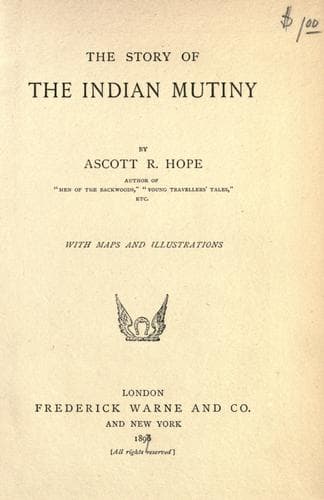
The Story of the Indian MutinyMoncrieff, A. R. Hope (Ascott Robert Hope)
History
The Story of the Indian Mutiny
Moncrieff, A. R. Hope (Ascott Robert Hope)
India -- History -- Sepoy Rebellion, 1857-1858
By the end of a week, with little further opposition, on March 21,
we had mastered the whole city, to find it almost deserted by its
terrified inhabitants, after enjoying for almost a year the doubtful
benefits of independence.
The British soldiers were now lodged in the palaces of Oudh, and might
stroll admiringly through the ruins of that wretched fortress which, in
the hands of their countrymen, had held out as many months as it had
taken them days to overcome the formidable works of the enemy. Their
victory was followed up by a proclamation from the Governor-General,
that in the opinion of many seemed harsh and unwise, since, with a few
exceptions, it declared the lands of Oudh forfeit to the conquering
power. The natural tendency of this was to drive the dispossessed
nobles and landowners into a guerilla warfare, in which they were
supported by the rebels escaped from Lucknow to scatter over the
country, taking as strongholds the forts and jungles that abound in it.
Nearly a year, indeed, passed before Oudh was fully pacified.
After sending out columns to deal with some of the most conspicuous
points of danger, Sir Colin moved into Rohilcund, his next task being
the reduction of its no less contumacious population. On May 5th, a
sharp fight decided the fate of Bareilly, its capital. Then he was
recalled by the Oudh rebels, growing to some head again under that
persistent foe the Moulvie. But, next month, the Moulvie fell in a
petty affray with some of his own countrymen--a too inglorious end for
one of our most hearty and determined opponents, who seems to have had
the gifts of a leader as well as of a preacher of rebellion.
Again may be hurried over a monotonous record of almost constant
success. The troops had suffered so frightfully from heat, that they
must now be allowed a little repose through the rainy season. With
next winter began the slow work of hunting down the rebels, in which
Sir Hope Grant took a leading part. By the spring of 1859, those still
in arms had been driven into Nepaul, or forced to take shelter in the
pestilential, tiger-haunted jungles of the Terai, while throughout
Hindostan burned bungalows were rebuilding, broken telegraph-posts
replacing, officials coming back to their stations; and the machinery
of law and order became gradually brought again into gear, under the
dread of a race that could so well assert its supremacy.
CHAPTER IX
THE EXTINCTION
Public-domain text, read in full here on John Shaqi.
Reviews
Reviews
No reviews yet
Be the first to share your thoughts on this work.
Elsewhere in the archive
Join the Discussion
Join the discussion
Sign in to leave a comment or review.
Sign InorCreate an account