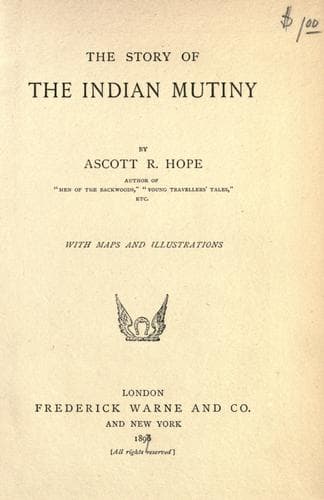
The Story of the Indian MutinyMoncrieff, A. R. Hope (Ascott Robert Hope)
History
The Story of the Indian Mutiny
Moncrieff, A. R. Hope (Ascott Robert Hope)
India -- History -- Sepoy Rebellion, 1857-1858
It has been impossible to note all the minor operations in this
confused war, and the isolated risings of which here and there we have
caught glimpses through the clouds of smoke overhanging the main field
of action--a mere corner of India, yet a region as large as England.
Thrills of sympathetic disaffection ran out towards Assam on the one
side, and to Goojerat on the other; up northwards into the Punjaub, as
we have seen, then through the Central Provinces, down into Bombay, and
to the great native state of Hyderabad, where the Nizam and his shrewd
minister Salar Jung managed to keep their people quiet, yet reverses on
our part might at any time have inflamed them beyond restraint.
Among the protected or semi-independent Courts of Rajpootana and
Central India there were serious troubles. Scindia and Holkar, the
chief Mahratta princes, stood loyal to us; but their soldiery took the
other side. The most remarkable case of hostility here was that of the
Ranee or Queen of Jhansi, a dispossessed widow, who had much the same
grievance against the British Government as Nana Sahib, and avenged it
by similar treacherous cruelty. She managed to blind the small English
community to their danger till the Sepoys broke out early in June with
the usual excesses; then our people, taking refuge in a fort, were
persuaded to surrender, and basely massacred. After this version of the
Cawnpore tragedy on a smaller scale, the Ranee had seized the throne of
her husband's ancestors, to defend it with more spirit than was shown
by the would-be Peshwa.
The whole heart of the Continent remained in a state of intermittent
disorder, and little could be done to put this down till the beginning
of 1858, when columns of troops from Madras and Bombay respectively
marched northward to clear the central districts, and rid Sir Colin
Campbell of the marauding swarms that thence troubled his rear. The
Bombay column, under Sir Hugh Rose, had the harder work of it. Fighting
his way through a difficult country, he first relieved the English who
for more than seven months had been holding out at Saugor; then moved
upon Jhansi, a strongly fortified city, with a rock-built citadel
towering over its walls.
Public-domain text, read in full here on John Shaqi.
Reviews
Reviews
No reviews yet
Be the first to share your thoughts on this work.
Elsewhere in the archive
Join the Discussion
Join the discussion
Sign in to leave a comment or review.
Sign InorCreate an account