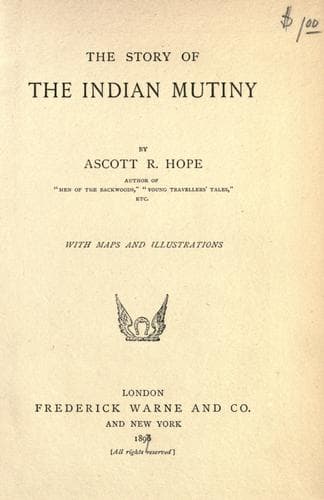
The Story of the Indian MutinyMoncrieff, A. R. Hope (Ascott Robert Hope)
History
The Story of the Indian Mutiny
Moncrieff, A. R. Hope (Ascott Robert Hope)
India -- History -- Sepoy Rebellion, 1857-1858
The Ranee was found determined to hold out, and on March 22nd a siege
of this formidable fortress had to be undertaken by two brigades of
European soldiers and Sepoys. At the end of a week, they in turn
became threatened by over twenty thousand rebels, under Tantia Topee,
advancing to raise the siege. Fifteen hundred men, only a third of them
Europeans, were all Sir Hugh Rose could spare from before the walls,
but with so few he faced this fresh army, that seemed able to envelop
his little band in far-stretching masses. Again, however, bold tactics
were successful against a foe that seldom bore to be assailed at an
unexpected point. Attacked on each flank by cavalry and artillery,
the long line of Sepoys wavered, and gave way at the first onset of
a handful of infantry in front. They fell back on their second line,
which had no heart to renew the battle. Setting fire to the jungle in
front of him, Tantia Topee fled with the loss of all his guns, hotly
pursued through the blazing timber by our cavalry and artillery.
Next day but one, April 3rd, while this brilliant victory was still
fresh, our soldiers carried Jhansi by assault. Severe fighting took
place in the streets round the palace; then the citadel was evacuated,
and the Ranee fled to Calpee, not far south of Cawnpore. Sir Hugh
Rose followed, as soon as he could get supplies, defeating Tantia
Topee once more on the road. Our most terrible enemy was the sun,
which struck down men by hundreds; the commander himself had several
sunstrokes, and more than half of one regiment fell out in a single
day. Half the whole force were in the doctor's hands; hardly a man
among them but was ailing. The rebels knew this weak point well, and
sought to make their harassing attacks in the mid-day heat. The want of
water also was most distressing at times; men and beasts went almost
mad with thirst, when tears could be seen running from the eyes of
the huge elephants sweltering on a shadeless plain, and the backs of
howling dogs were burned raw by the cruel sun.
But the work seemed almost done, and in confidence of full success Sir
Hugh Rose did not wait for the Madras column, which should now have
joined him, but could not come up in time. At Calpee, the arsenal of
the rebels, were the Ranee and Rao Sahib, a nephew of the Nana. This
place also was a picturesque and imposing fortress that might well have
delayed the little army. But the infatuated enemy, driven to madness
by drugs and fanatical excitement, swarmed out into the labyrinth of
sun-baked ravines before it, to attack our fainting soldiers; then they
met with such a reception as to send them flying, not only from the
field, but from the town, and their arsenal, with all its contents,
fell an easy prey to the victors. This march of a thousand miles,
though so briefly related, was distinguished by some of the finest
feats of arms in the whole war.
Public-domain text, read in full here on John Shaqi.
Reviews
Reviews
No reviews yet
Be the first to share your thoughts on this work.
Elsewhere in the archive
Join the Discussion
Join the discussion
Sign in to leave a comment or review.
Sign InorCreate an account