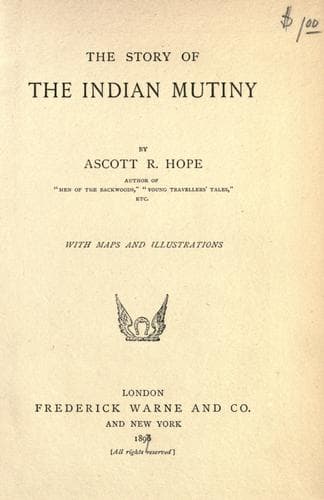
The Story of the Indian MutinyMoncrieff, A. R. Hope (Ascott Robert Hope)
History
The Story of the Indian Mutiny
Moncrieff, A. R. Hope (Ascott Robert Hope)
India -- History -- Sepoy Rebellion, 1857-1858
Heavy could not but be the punishment that visited this unhappy land.
Not a few of the mutineers were spared in battle to die by inches in
some unwholesome jungle, or slunk home, when they durst, only to meet
the curses of the friends upon whom they had brought so much misery,
and to be at a loss how to earn their bread, pay and pension having
been scattered to the winds of rebellion. The sufferings of the civil
population, even where they had not risen in arms, were also pitiable;
and if hundreds of homes in England had been bereaved, there would be
thousands of dusky heathen to mourn their dear ones. The country was
laid waste in many parts; towns and palaces were ruined; landowners
were dispossessed, nobles driven into beggary among the multitude of
humbler victims, whose very religion was insulted to bring home to them
their defeat. A favourite mode of execution was blowing prisoners away
from the mouth of guns, through which they believed themselves doomed
in the shadowy life beyond death; and where they came to be hanged,
the last rude offices were done by the eternally profaning touch of
the sweeper caste. The temples on the river-side at Cawnpore had been
blown up, as a sacrifice to the memory of our massacred country-people.
The mosques and shrines of Delhi were thrown open to the infidel.
Immediately after its capture, there had even been a talk of razing
this great city to the ground, that its magnificence might be forgotten
in its guilt.
The old king had paid dearly for that short-lived attempt to revive the
glories of his ancestors. Tried by court-martial, he was transported
to Rangoon, where he soon died in captivity. Certain other potentates
were punished, and some rewarded at their expense, for varying conduct
during a crisis when most of them had the same desire to be on the
winning side, but some played their game more skilfully or more luckily
than others. Nana Sahib, the most hateful of our enemies, escaped the
speedy death that awaited him if ever he fell into British hands. He
fled to the Himalayas with a high price on his head, and his fate was
never known for certain; but the probability is that long ago he has
perished more miserably than if he had been brought to the gallows.
The Power which had set up and pulled down so many princes became
itself dispossessed and abolished through the upheavings of the
Mutiny. In England, it was felt on all hands that such an empire as
had grown out of our Eastern possessions, should no longer be left
under the control of even a so dignified body as the East India
Company. The realm won by private or corporate enterprise was annexed
to the dominions of the British Crown; and on Nov. 1, 1858, the same
proclamation which offered amnesty to the submissive rebels, declared
that henceforth the Queen of England ruled as sovereign over India.
Public-domain text, read in full here on John Shaqi.
Reviews
Reviews
No reviews yet
Be the first to share your thoughts on this work.
Elsewhere in the archive
Join the Discussion
Join the discussion
Sign in to leave a comment or review.
Sign InorCreate an account