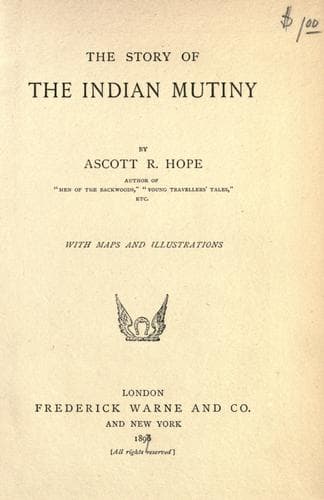
The Story of the Indian MutinyMoncrieff, A. R. Hope (Ascott Robert Hope)
History
The Story of the Indian Mutiny
Moncrieff, A. R. Hope (Ascott Robert Hope)
India -- History -- Sepoy Rebellion, 1857-1858
In 1877, Queen Victoria was proclaimed Empress at Delhi, amid an
imposing assemblage both of actual rulers and of gorgeous native
potentates bearing time-honoured titles, who thus fully acknowledged
themselves vassals of the Power that in little more than a century had
taken the place of the Great Mogul.
Our rule in India has now become marked by a feature almost new
in the history of conquerors. We begin to recognize more and more
clearly that we owe this subjugated land a debt in the elevation of
her long-oppressed millions. With this duty comes a new source of
danger. By the very means we take here to raise up a sense of common
welfare, and through the destruction of those petty tyrannies that
hitherto held apart the elements of national life, we are teaching the
agglomeration of races to whom we have given a common name to look on
themselves as one people, still too much differing from us in interests
and sympathies; and it is to be feared that their growth in healthy
progress does not keep pace with the hot-headed and loud-tongued
patriotism of some who, in the schools of their rulers, have learned
rather to talk about than to be fit for freedom. Though such noisy
discontent is chiefly noted among the classes least formidable in arms,
while the more warlike seem not unwilling to accept our supremacy,
if ever another rebellion took place, we should have to deal with a
less unorganized sentiment of national existence, and perhaps with the
deeper and wider counsels, for want of which mainly, we have seen how
the Mutiny miscarried, that else might have swept our scanty force out
of India. On the other hand, in such a future emergency, we should have
the advantage both of the improved scientific arms, so decisive in
modern warfare, the use of which we now take more care to keep in our
own hands, and of those better means of communication with the East,
gained within the lifetime of our generation. In less than a month, we
could throw into India as many English soldiers as, in 1857, arrived
only in time to stamp out the embers of an almost ruinous conflagration.
In any case, the conscience of England has set up a new standard to
judge its achievements--by the good we can do to this great people, and
not by the gain we can wring from them, the honour of our mastery must
stand or fall.
Public-domain text, read in full here on John Shaqi.
Reviews
Reviews
No reviews yet
Be the first to share your thoughts on this work.
Elsewhere in the archive
Join the Discussion
Join the discussion
Sign in to leave a comment or review.
Sign InorCreate an account