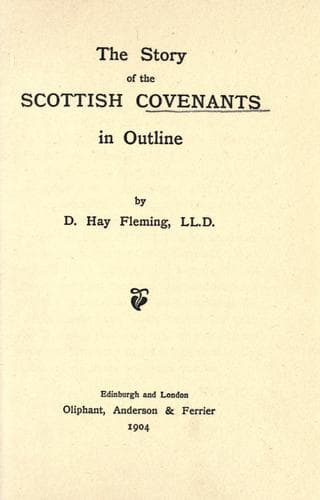
The Story of the Scottish Covenants in Outline — John Shaqi
The Story of the Scottish Covenants in OutlineFleming, David Hay
History
The Story of the Scottish Covenants in Outline
Fleming, David Hay
Covenanters; Covenanters -- Scotland -- History; Covenants (Church polity); Scotland -- Church history
Beginning at the left hand is Johnston of Warriston showing a letter to
the Earl of Argyll, while Lord Eglinton is in the rear. Two ladies come
next—the Marchioness of Hamilton, in widow’s weeds, seated, with Lady
Kenmure standing beside her. The group around the tombstone includes
Lord Rothes in the act of signing the document, Lord Louden, Lord
Lothian, and the Earl of Sutherland; while Montrose is on the near side.
Then there are Hope of Craighall, with the Rev. Samuel Rutherfurd, and
in the foreground, standing on a tombstone, is the Rev. Alexander
Henderson.
------------------------------------------------------------------------
[Illustration: Signing of the National Covenant]
------------------------------------------------------------------------
The Story
of the
SCOTTISH COVENANTS
in Outline
Scotland is pre-eminently the land of the Covenant, and the land is
flowered with martyr graves. When the covenanting cause was in the
ascendant, many were willing to appear on its side who cared little for
it in reality; but when it waned, and, after the Restoration, the time
of trial came, the half-hearted changed sides, or fell away like leaves
in autumn, and the love of many waxed cold. Then it was that the
faithful remnant stood revealed and grew still more faithful.
While they were opposed and oppressed by some of their former
associates, they were, on the other hand, reinforced by the accession of
outstanding men, like Richard Cameron and Thomas Forrester, who, in
their earlier years, had complied with Prelacy; and by others, like
James Renwick, Patrick Walker, and Sergeant Nisbet, who were born after
the persecution had actually commenced. Men, and even women, were found
ready and willing to endure all hardships, and to brave an ignominious
death, rather than relinquish or compromise the principles which they
held so dear, and to which, as they believed, the nation was bound by
solemn covenants.
[Sidenote: Bands or Covenants]
The story of religious covenanting in Scotland covers a long period. The
covenants, or bands as they were frequently called, may be divided into
three classes—public, semi-public, and private—and the influence of each
has been felt at some of the most critical periods in the history of the
country.
[Sidenote: Personal Covenants]
The private or personal covenant, in which the individual Christian gave
up himself, or herself, formally to the service of God, helped many a
one to walk straight in crooked and trying times. These private
transactions were neither less solemn nor less sacred because the
knowledge of them was confined to the covenanter and his Lord.
[Sidenote: A Specimen]
Public-domain text, read in full here on John Shaqi.
Reviews
Reviews
No reviews yet
Be the first to share your thoughts on this work.
Join the Discussion
Join the discussion
Sign in to leave a comment or review.
Sign InorCreate an account