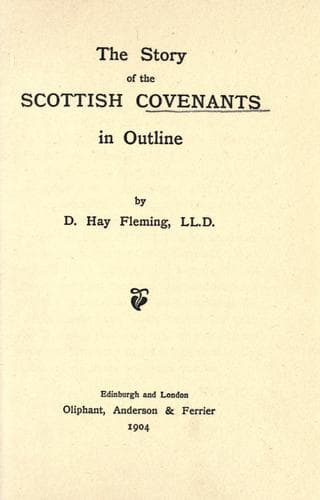
The Story of the Scottish Covenants in OutlineFleming, David Hay
History
The Story of the Scottish Covenants in Outline
Fleming, David Hay
Covenanters; Covenanters -- Scotland -- History; Covenants (Church polity); Scotland -- Church history
The devout and gentle but resolute Renwick, having been sent to Holland
for ordination, returned in the autumn of 1683 to the arduous and
dangerous post which had been so honourably held by Cameron and Cargill,
and they could not have had a worthier successor. In November 1684, the
Cameronians published their “Apologetick Declaration and Admonitory
Vindication,” in which they adhered to their former declarations against
Charles Stuart, and warned those who sought their lives or gave
information against them, that in future they would regard them as the
enemies of God and of the covenanted work of reformation, and would
punish them as such. The Privy Council met this declaration by ordaining
that those who owned it, or would not disown it upon oath, should be
immediately put to death whether they had arms or not. This was to be
always done “in presence of two witnesses, and the person or
persons having commission from the Council for that effect.”
The darkest time of the persecution, the period specially known
as “the killing-time,” had now arrived; prisoners had already been
hurried to death three hours after receiving sentence.
The infamous Lauderdale had been constrained to demit his office in
1680, and his life in 1682; Rothes had predeceased him by a year; and
now they were to be followed into another world by the crowned scoundrel
(otherwise “His most Sacred Majesty”) for whose favour they had
persecuted the followers of that cause which all three had sworn to
maintain. By the death of Charles the Second, on the 6th of February
1685, no relief came to those who were hunted like partridges on the
hills of Scotland.
[Sidenote: Priesthill and Wigtown]
The heartless sensualist was now to be succeeded by him who combined
unrelenting bigotry with lechery. Charles had long been suspected of
more than secret leanings to the Church of Rome; James was an avowed and
ardent Papist. It was on the 1st of the following May that, under
Claverhouse, the dread scene was enacted at Priesthill, when John Brown
was taken to his own door, and shot in presence of his wife and child;
and on the 11th of the same month that this cold-blooded cruelty was
rivalled by Lag at Wigtown, when Margaret Wilson and Margaret Lauchlison
(or M’Lauchlan) were tied to stakes and drowned by the rising tide.
[Sidenote: Conventicles]
Public-domain text, read in full here on John Shaqi.
Reviews
Reviews
No reviews yet
Be the first to share your thoughts on this work.
Join the Discussion
Join the discussion
Sign in to leave a comment or review.
Sign InorCreate an account