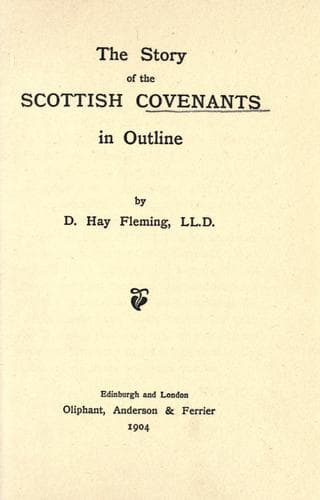
The Story of the Scottish Covenants in OutlineFleming, David Hay
History
The Story of the Scottish Covenants in Outline
Fleming, David Hay
Covenanters; Covenanters -- Scotland -- History; Covenants (Church polity); Scotland -- Church history
Argyll’s rising was a failure. He was captured, brought to Edinburgh,
and there beheaded on the 30th of June 1685, not for the rising, but
because in November 1681 he had ventured to take the Test with an
explanation. Being dissatisfied with Argyll’s Declaration and with his
associates, Renwick and his followers stood aloof from that rising; but,
on the 28th of May 1685, they had, at Sanquhar, formally protested
against the validity of the Scottish Parliament then in session, and
also against the proclamation of James, Duke of York, as King. They also
refused to take any benefit from the toleration, which he granted, by
his “sovereign authority, prerogative royal, and absolute power,” on the
28th of June 1687—a toleration which was gratefully accepted by many of
the less scrupulous Presbyterian ministers. Although Argyll’s attempt to
overturn the throne of James the Seventh was unsuccessful, the time
came, in December 1688, when he had to escape from the country, which
was no longer to be his. Next April the Scottish Convention of Estates
pointed out that he had assumed the regal power in Scotland, and acted
as king, without taking the oath required by law, whereby the king is
obliged to swear to maintain the Protestant religion, and to rule the
people according to the laws.
[Sidenote: The Revolution]
Renwick, who glorified God in the Grassmarket on the 17th of February
1688, was the last Covenanter who suffered on a scaffold. He and his
followers, by maintaining an unflinching protest against the reign of
James, had helped to hasten his downfall. When the Convention of Estates
met in Edinburgh, the Cameronians gladly volunteered to defend it; and
showed their loyalty by raising in a single day, without tuck of drum,
eleven hundred and forty men as a regiment for King William’s service.
Episcopacy was abolished by the Scottish Parliament (22nd July 1689) as
an insupportable grievance; and (7th June 1690) Presbytery was
re-established, and the Westminster Confession of Faith ratified; but
the Covenants were ignored, and on that account the sterner Cameronians
still stood apart, and, with that dogged tenacity which had
distinguished them in the past, they held together, although for many
long years they had no minister.
[Sidenote: The Martyrs’ Monument]
[Sidenote: Estimated Number of Victims]
Public-domain text, read in full here on John Shaqi.
Reviews
Reviews
No reviews yet
Be the first to share your thoughts on this work.
Join the Discussion
Join the discussion
Sign in to leave a comment or review.
Sign InorCreate an account