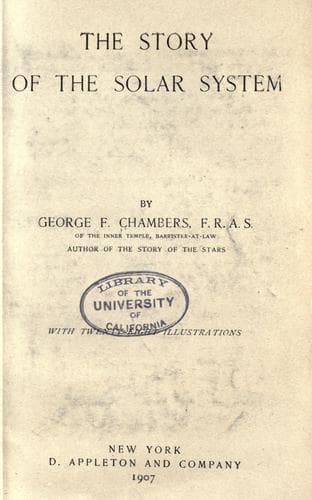
The Story of the Solar SystemChambers, George F. (George Frederick)
Science
The Story of the Solar System
Chambers, George F. (George Frederick)
Solar system
It is extremely probable that as time goes on we shall be able to say
that an intimate connection subsists between particular comets which
have been and particular meteoric swarms. We already possess proof that
other comets which once came within our view were at that time revolving
round the Sun in orbits so comparatively small that they should have
reappeared at intervals of half-a-dozen or so years, yet they have not
reappeared. The question therefore suggests itself, Have they been
subject to some great internal disaster which has led to their
disintegration? It may be said without doubt that this is in the highest
degree probable; but short of this, that is short of total
disintegration into small fragments, we have several cases on record of
what I may, for the moment, call ordinary comets breaking up into two or
three fragments. For a long while astronomers were naturally loath to
believe that this was possible, and therefore they discredited the
statements to that effect which had been made. Though it would occupy
too much space to give the particulars of these comets in full it may
yet be worth while just to mention the names of some of them, presumed
to be of short period, which seemed nevertheless to have eluded our
grasp. I would here specially mention Liais’s Comet of 1860 and the
second comet of 1881 as seemingly having undergone some sort of
disruption akin to what happened in the case of Biela’s Comet.
There is another group of periodical comets to be mentioned. These are
six in number and seem to have periods of 70 years or a little more. Of
these three have not yet given us the chance of seeing them again; two
have paid us a second visit, and therefore their periods are not open to
doubt; whilst the most famous of this group, “Halley’s,” has been
recorded to have shown itself to the Earth no less than 25 times,
beginning with the year 11 B. C. It was Halley’s comet which shone over
Europe in April 1066, and was considered the forerunner of the conquest
of England by William of Normandy. It figures in the famous Bayeux
tapestry as a hairy star of strange shape.
It would seem that there exists in some inscrutable manner a connection
between each of the three great exterior planets and certain groups of
comets. In the case of Jupiter the association is so very pronounced as
long ago to have attracted notice; but the French astronomer,
Flammarion, has brought forward some suggestions that Saturn has one
comet (and perhaps two) with which it is associated; Uranus, two (and
perhaps three); and Neptune, six; whilst farther off than Neptune the
fact that there are two comets, supposed periodical, without a known
planet to run with them has inspired Flammarion to look with a friendly
eye on the idea (often mooted) that outside of Neptune there exists
another undiscovered planet revolving round the sun in a period of about
300 years.
Public-domain text, read in full here on John Shaqi.
Reviews
Reviews
No reviews yet
Be the first to share your thoughts on this work.
Elsewhere in the archive
Join the Discussion
Join the discussion
Sign in to leave a comment or review.
Sign InorCreate an account