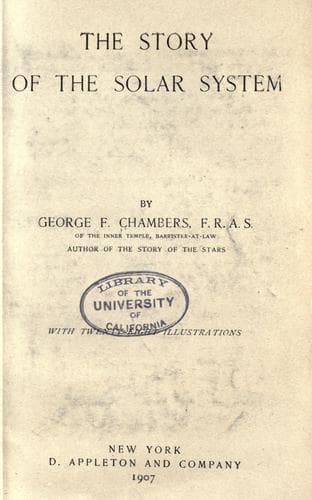
The Story of the Solar SystemChambers, George F. (George Frederick)
Science
The Story of the Solar System
Chambers, George F. (George Frederick)
Solar system
The Jupiter group of comets deserves a few additional words. There are
certainly nine, and perhaps twelve comets revolving round the Sun in
orbits of such dimensions that they either reach up to or slightly
overreach the orbit of Jupiter. The effect of this condition of things
is that on occasions Jupiter and each of the comets may come into such
proximity that the superior mass of Jupiter may exercise a very
seriously disturbing influence over a flimsy and ethereal body like a
comet. There is reason to suppose that some of the comets now belonging
to the Jupiter group have not done so for any great length of time, but
having been wandering about, either in elliptic orbits of great extent,
or even in parabolic orbits, have accidentally come within reach of
Jupiter, and so have been, as it were, captured by him. Hence, the
origin of the term, the “capture theory,” as applied to these family
groups of comets which I have just stated to exist, each presided over,
as it were, by a great planet. It may be that at some future time this
theory will help us to a clue to the fact that besides the comets of
Lexell of 1770, Blainpain of 1819, and Di Vico of 1844, short period
comets unaccountably missing, there are several others presumed to have
been revolving in short period orbits when discovered, and as to which
it is very strange that they should not have been seen before their only
recorded visit to us, and equally strange that they should never have
been seen since.
Is there any reason to fear the results of a collision between a comet
and the Earth? None whatever. However vague may be, and in a certain
sense must be, our answer to the question, “What is a comet?” certain is
it that every comet is a very imponderable body—a sort of airy nothing,
a mass of gas or vapour.[6] At the same time it always has been and
perhaps still is difficult to persuade the public that whatever might be
the effect on a comet if it were to strike the Earth, the effect on the
Earth, were it to be struck by a comet, would be _nil_. This is not
altogether a matter of speculation, for according to a calculation by
Hind, on June 30, 1861, the Earth passed into and through the tail of
the great comet of that year at about two-thirds of its distance from
the nucleus. Assuredly there was no dynamical result; but it seems,
however, not unlikely that there was an optical result; at any rate,
traces of something of this sort were noted. Hind himself, in Middlesex,
observed a peculiar phosphorescence or illumination of the sky which he
attributed at the time to an auroral glare. Lowe, in Nottinghamshire
confirmed Hind’s statement of the appearance of the heavens on the same
day. The sky had a yellow auroral glare-like look, and the Sun, though
shining, gave but feeble light. The comet was plainly visible at 7.45 p.
m. (during sunshine), and had a much more hazy appearance than on any
subsequent evening. Lowe adds that his Vicar had the pulpit candles
Public-domain text, read in full here on John Shaqi.
Reviews
Reviews
No reviews yet
Be the first to share your thoughts on this work.
Elsewhere in the archive
Join the Discussion
Join the discussion
Sign in to leave a comment or review.
Sign InorCreate an account