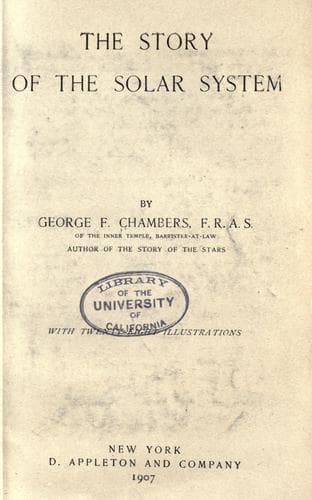
The Story of the Solar SystemChambers, George F. (George Frederick)
Science
The Story of the Solar System
Chambers, George F. (George Frederick)
Solar system
Astronomers are not altogether agreed as to the propriety of this
explanation. One argument against it is that with _perhaps_ one
exception none of the other short-period comets (all of them small and
presumably deficient in density) seem affected as Encke’s is. On the
other hand Sir John Herschel favoured the explanation just given, as
also does Hind who is the highest living authority on comets. A German
mathematician, Von Asten, who devoted immense labour to the study of the
orbit of Encke’s Comet, thought there should be no hesitation in
accepting the idea of a resisting medium, subject to the limitation that
it does not extend beyond the orbit of Mercury. Von Asten’s allusion to
Mercury touches a subject which belongs more directly to the question of
Mercury’s orbit and to that other very interesting question, “Are there
any planets, not at present known, revolving round the Sun within the
orbit of Mercury.”
Which is the largest and most magnificent comet recorded in history? It
is virtually impossible to answer this question, because of the
extravagant and inflated language made use of by ancient and medieval (I
had almost added, and modern) writers. There is no doubt that the comet
of 1680, studied by Sir I. Newton, the tail of which was curved, and
from 70° to 90° long, must have been one of the finest on record, as it
was also the one which came nearest to the Sun, for it almost grazed the
Sun’s surface.
The comet of 1744, visible as it was in broad daylight, was, no doubt,
the finest comet of the 18th century, though in size it has been
surpassed; yet its six tails must have made it a most remarkable object.
So far as the 19th century is concerned, our choice lies between the
comets of 1811, 1843, 1858, and 1861. The comet of 1811 is spoken of by
Hind as “perhaps the most famous of modern times. Independently of its
great magnitude, the position of the orbit and epoch of perihelion
passage, were such as to render it a very splendid circumpolar object
for some months.” The tail as regards its length was not so very
remarkable, for at its best, in October 1811, it was only about 25°
long, its breadth, however, was very considerable; at one time 6°, the
real length of the tail, about the middle of October, was more than
100,000,000 of miles, and its breadth about 15,000,000 of miles. The
visibility of this comet was coincident with those events which proved
to be the turning-point in the career of Napoleon I., and there were not
wanting those who regarded the comet as a presage of his disastrous
failure in Russia. Owing to the long period (17 months), during which
this comet was visible, it was possible to determine its orbit with
unusual precision. Argelander found its period to be 3065 years, with no
greater uncertainty than 43 years. The great dimensions of its orbit
will be realised when it is stated that this comet recedes from the Sun
to a distance of 14 times that of the planet Neptune.
Public-domain text, read in full here on John Shaqi.
Reviews
Reviews
No reviews yet
Be the first to share your thoughts on this work.
Elsewhere in the archive
Join the Discussion
Join the discussion
Sign in to leave a comment or review.
Sign InorCreate an account