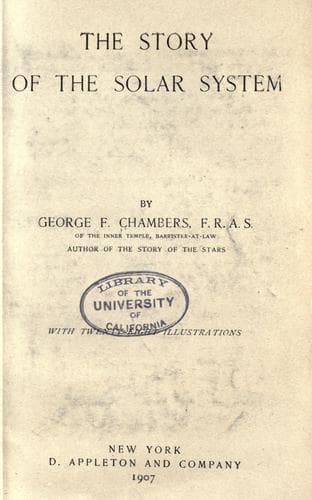
The Story of the Solar SystemChambers, George F. (George Frederick)
Science
The Story of the Solar System
Chambers, George F. (George Frederick)
Solar system
lighted in the Parish Church at 7 o’clock (it was a Sunday), though only
five days had elapsed since Midsummer day, which itself proves that some
sensation of darkness was felt even while the Sun was shining.
So far as I remember there has been no such thing as a comet panic
during the present generation, at any rate in civilised countries, but
it is on record that there was a very considerable panic in 1832 in
connection with the return of Biela’s Comet in the winter of that year.
Olbers as the result of a careful study in advance of the comet’s
movements found that the comet’s centre would pass only 20,000 miles
within the Earth’s orbit, and that as the nebulosity of the comet had in
1805 been more than 20,000 miles in diameter, it was certain, unless its
dimensions had diminished in the 27 years, that some of the comet’s
matter would overlap the Earth’s orbit; in other words would envelop the
Earth itself, if the Earth happened to be there. This conclusion when it
became public was quite enough to create a panic and make people talk
about the forthcoming destruction of our globe. It was nothing to the
point (in the public mind) that astronomers were able to predict that
the Earth would not reach the place where the comet would cross the
Earth’s orbit until four weeks after the comet had come and gone.
However, we now know that nothing happened, and I am justified in adding
that even if there had been contact, Earth meeting comet face to face,
nothing (serious) would have occurred so far as the Earth was concerned.
This seems a convenient place for referring to a matter which when it
was first broached excited a great deal of interest, but about which one
does not hear much now-a-days. The period of the small comet known as
Encke’s (which, revolving as it does round the Sun in a little more than
three years, has the shortest period of any of the periodical comets)
was found many years ago to be diminishing at each successive return.
That is to say, it always attained its nearest distance from the Sun at
each apparition 2½ hours sooner than it ought to have done. In order to
account for this gradual diminution in the comet’s period Encke
conjectured the existence of a thin ethereal medium sufficiently dense
to affect a light flimsy body like a comet, but incapable of obstructing
a planet. It has been remarked by Hind that “this contraction of the
orbit must be continually progressing, if we suppose the existence of
such a medium; and we are naturally led to inquire, What will be the
final consequence of this resistance? Though the catastrophe may be
averted for many ages by the powerful attraction of the larger planets,
especially Jupiter, will not the comet be at last precipitated on the
Sun? The question is full of interest, though altogether open to
conjecture.”
Public-domain text, read in full here on John Shaqi.
Reviews
Reviews
No reviews yet
Be the first to share your thoughts on this work.
Elsewhere in the archive
Join the Discussion
Join the discussion
Sign in to leave a comment or review.
Sign InorCreate an account