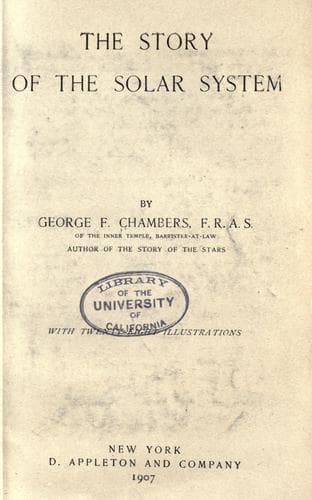
The Story of the Solar SystemChambers, George F. (George Frederick)
Science
The Story of the Solar System
Chambers, George F. (George Frederick)
Solar system
All the available evidence which we possess may be said to show that the
spots are not merely superficial appearances, but that they have their
origin deep in the interior of the Sun, and are produced by the
operation of causes still unknown to us which affect and disturb the
Sun’s mass to an extent which is sometimes very considerable. The spots
then are only the results of a great agitation in the materials of which
the Sun is composed, and this agitation extends far down below the
limits of the visible dark nucleus whatever that may consist of.
Besides the spots, streaks of light may frequently be remarked upon the
surface of the Sun towards the margin of the disc. These are termed
_faculæ_ (torches), and they are often found near the spots, or where
spots have previously existed or have afterwards appeared. When quite
near the Sun’s limb these faculæ are usually more or less parallel to
the limb. They are of irregular form and may be likened to certain kinds
of coral. They generally appear to be more luminous than the solar
surface immediately adjacent to them, but it is not improbable that this
is an optical illusion depending upon the fact that the edges of the Sun
always appear much more luminous than the centre. This last-named fact
may be readily recognised by the employment of a high magnifying power,
and moving the telescope rapidly from the limb to the centre of the
disc. If the Sun be projected on a screen, as already mentioned, this
degradation of the Sun’s light from centre to circumference becomes
particularly manifest.
After having studied the structure and the movement of the spots, one is
naturally led to ask if their apparitions at different periods are
subject to any general law. This question is one which has much engaged
the attention of modern astronomers. The older observers noticed that
the number of the spots visible differed in different years. There were
said to have been periods when months and even years passed away without
any spots being observed. Even allowing that this statement, so far as
“years” are concerned, might be exaggerated, and that the absence of
spots was due to the want of sufficient care in making the observations,
and especially to the want of efficient instruments, it is none the less
true that the number of the spots is extremely variable, and that there
have been epochs when they were very scarce.
Sir W. Herschel was the first who devoted himself to the question of
seeking to establish a relation between the variation of the spots and
terrestrial meteorology. For the want of any better object, he compared
the annual number of the spots with the price of wheat; but it is easy
to see that nothing could result from such a comparison. Without doubt
the meteorological phenomena of the globe must depend to some extent on
solar changes: but the term of comparison selected by Herschel had no
direct bearing on the state of the Sun.
Public-domain text, read in full here on John Shaqi.
Reviews
Reviews
No reviews yet
Be the first to share your thoughts on this work.
Join the Discussion
Join the discussion
Sign in to leave a comment or review.
Sign InorCreate an account