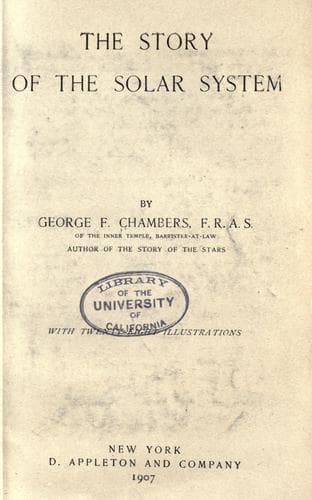
The Story of the Solar SystemChambers, George F. (George Frederick)
Science
The Story of the Solar System
Chambers, George F. (George Frederick)
Solar system
Holmes’s Comet, the Head on Nov. 9, 1892 (_Denning_) 159
23. Holmes’s Comet, the Head on Nov. 16, 1892 (_Denning_) 159
24. Comet III. of 1862, on Aug. 22, showing Jet of Luminous Matter
(Challis) 160
25. Sawerthal’s Comet, June 4, 1888 (Charlois) 165
26. Biela’s Comet, 1846 169
27. The Great Comet of 1811 177
28. The Great Comet of 1882 179
THE
STORY OF THE SOLAR SYSTEM.
CHAPTER I.
INTRODUCTORY STATEMENT.
By the term “Solar System” it is to be understood that an Astronomer,
speaking from the standpoint of an inhabitant of the Earth, wishes to
refer to that object, the Sun, which is to him the material and visible
centre of life and heat and control, and also to those bodies dependent
on the Sun which circulate round it at various distances, deriving their
light and heat from the Sun, and known as planets and comets. The
statement just made may be regarded as a general truth, but as the
strictest accuracy on scientific matters is of the utmost importance, a
trivial reservation must perhaps be put upon the foregoing broad
assertion. There is some reason for thinking that possibly one of the
planets (Jupiter) possesses a little inherent light of its own which is
not borrowed from the Sun; whilst of the comets it must certainly be
said that, as a rule, they shine with intrinsic, not borrowed light.
Respecting these reservations more hereafter.
The planets are divided into “primary” and “secondary.” By a “primary”
planet we mean one which directly circulates round the Sun; by a
“secondary” planet we mean one which in the first instance circulates
round a primary planet, and therefore only in a secondary sense
circulates round the Sun. The planets are also “major” or “minor”; this,
however, is only a distinction of size.
The secondary planets are usually termed “satellites,” or, very often,
in popular language, “moons,” because they own allegiance to their
respective primaries just as our Moon—_the_ Moon—does to the Earth. But
the use of the term “moon” is inconvenient, and it is better to stick to
“satellite.”
There is yet another method of classifying the planets which has its
advantages. They are sometimes divided into “inferior” and “superior.”
The “inferior” planets are those which travel round the Sun in orbits
which are inside the Earth’s orbit; the “superior” planets are those
whose orbits are outside the Earth.
The following is an enumeration of the major planets in the order of
their distances, reckoning from the Sun outwards:—
1. Mercury.
2. Venus.
3. The Earth.
4. Mars.
5. Jupiter.
6. Saturn.
7. Uranus.
8. Neptune.
Public-domain text, read in full here on John Shaqi.
Reviews
Reviews
No reviews yet
Be the first to share your thoughts on this work.
Join the Discussion
Join the discussion
Sign in to leave a comment or review.
Sign InorCreate an account