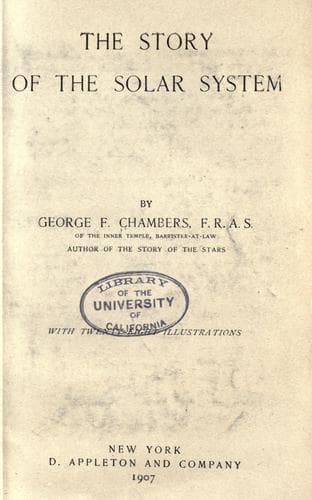
The Story of the Solar SystemChambers, George F. (George Frederick)
Science
The Story of the Solar System
Chambers, George F. (George Frederick)
Solar system
According to Wolf, the attraction of the planets, or of some of them, is
the real cause of the periodicity which we are dealing with; that
attraction producing on the surface of the solar globe true tides, which
give birth to the spots, these tides themselves experiencing periodic
variations owing to the periodic changes of position of the celestial
bodies which cause them. It has even been thought safe to assert that
the fact of the principal period coinciding with the revolution of
Jupiter is of momentous significance; but this coincidence seems purely
accidental, and no certain conclusion can be drawn as to this matter.
The influence of Mercury and Venus would perhaps be much more potent,
for their distance from the Sun is not very great, and this should
render their influence more sensible. On the other hand, their masses
appear to be too small to be capable of producing any sufficient effect.
De La Rue, Balfour Stewart, and Löwy most perseveringly studied this
point of solar physics. They seem to have arrived at the conclusion that
the conjunctions of Venus and Jupiter do exercise a certain amount of
influence on the number of the spots and on their latitude; and that
this influence is less considerable when Venus is situated in the plane
of the solar equator. At any rate it is a fact, that a great number of
the visible inequalities in a duly plotted curve of the spots do really
correspond to special positions of these two planets.
In order to determine with more precision these coincidences and the
importance which attaches to them, De La Rue extended his inquiries. He
separately analysed many different groups of spots, selecting for his
purpose more particularly those of which the observations happened to
have been specially continuous and complete, giving a preference
moreover to those which had been observed in the central portions of the
Sun’s disc. From an investigation of 794 groups De La Rue arrived at the
following conclusions:—(1) If we take a meridian passing through the
middle of the disc and represented by a diameter perpendicular to the
equator, we find that the mean size of the spots is not the same with
regard to that meridian. It appears certain that the correction required
for perspective does not suffice to explain this difference; and that
another element must be introduced in order to secure that the apparent
dimensions of the spots may be the same on both sides. We do not yet
possess a very clear explanation of this fact; but the most probable is
this:—the spots are surrounded by a projecting bank, which seems to
disappear in part during their transit across the Sun. This bank is more
elevated on the preceding than on the following side; accordingly, the
spots ought to seem smaller when they are in the eastern half of the
disc; larger when they are in the western half; for in the first
position the observer’s eye meets an elevated obstacle, which hides a
portion of the spot itself.
Public-domain text, read in full here on John Shaqi.
Reviews
Reviews
No reviews yet
Be the first to share your thoughts on this work.
Join the Discussion
Join the discussion
Sign in to leave a comment or review.
Sign InorCreate an account