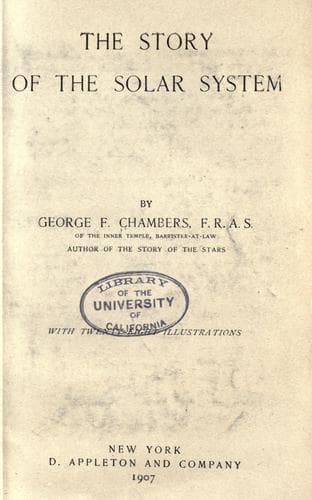
The Story of the Solar SystemChambers, George F. (George Frederick)
Science
The Story of the Solar System
Chambers, George F. (George Frederick)
Solar system
The reader who has followed me thus far will by this time be in a
position to appreciate a remark made in an earlier part of this chapter,
that the multitude of facts known to us in connection with the Sun and
its spots is so great, as to render it impossible to exhibit in a single
chapter anything more than the barest outline of them. The numerous
observations of recent eclipses of the Sun, especially since that of
1860, and the extensive application of the spectroscope to the Sun both
in connection with these eclipses, and generally, may be said to have
completely revolutionised our knowledge of solar phenomena during the
present generation; or perhaps it might be more correct to say have
enormously increased our knowledge of the facts of the case and have
revolutionised in no small degree the conclusions deduced from the
facts.
CHAPTER III.
MERCURY.
So far as we know at present, Mercury is the nearest planet to the Sun.
The circumstances under which it presents itself to us and a brief
general account of its movements have already been stated. In the
present chapter, therefore (and this remark applies in substance to each
of the succeeding chapters appropriated to particular planets), I shall
limit myself to such topics as seem to be of interest to an observer
armed with a telescope. Mercury, as already mentioned, exhibits from
time to time phases which may be said to be the same as those of the
moon; but as the only chance of seeing it is when it is at its greatest
distance east or west of the Sun, practically it can only be studied
when in, or rather near to, what may be called the half-moon phase; and
even then observations on its physical appearance can only be obtained
with difficulty. Perhaps its most definite feature is its colour. This,
undoubtedly, is more or less pink. Strange to say, in spite of the
multiplication of telescopes and observers, comparatively little
attention has been paid to this planet, and we really know very little
more about it than Schröter told us nearly a hundred years ago. He
obtained what he conceived to be satisfactory evidence of the existence
of at any rate one mountain, having a height of about 11 English miles—a
height which it will be noted, far exceeds, not only relatively but
absolutely, any mountain on the earth. What Schröter based this
conclusion upon was the fact that when the planet was near inferior
conjunction, the southern horn presented a truncated appearance, which
might be the result of a lofty projection arresting the Sun’s light.
Schröter also announced that Mercury rotated on its axis in 24 hours 5
minutes. Sir W. Herschel failed to satisfy himself that Schröter’s
conclusions were well-founded, but it must certainly be admitted that
some support for them is furnished by certain observations made within
the last few years. It is matter for regret, however, that most of these
Public-domain text, read in full here on John Shaqi.
Reviews
Reviews
No reviews yet
Be the first to share your thoughts on this work.
Join the Discussion
Join the discussion
Sign in to leave a comment or review.
Sign InorCreate an account