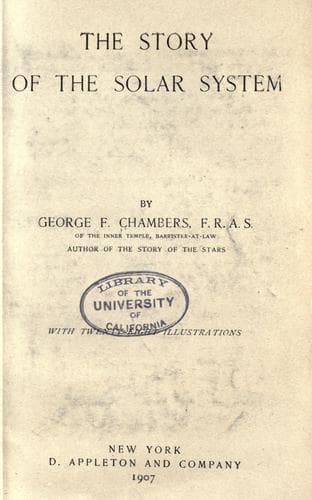
The Story of the Solar SystemChambers, George F. (George Frederick)
Science
The Story of the Solar System
Chambers, George F. (George Frederick)
Solar system
Some observers have thought that Mercury is more easy to observe than
Venus, and that, speaking generally, its surface, if we could only get
to see it constantly under favourable circumstances, might be considered
to resemble in most respects that of Mars. Mercury revolves round the
Sun at a mean distance of 36 millions of miles. Owing, however, to the
fact that the eccentricity of its orbit (or its departure from the
circular form) is greater than that of any of the other major planets,
it may approach to within 28½ millions of miles or recede to more than
43 millions of miles. Its apparent diameter varies between 4½″ in
superior conjunction to 13″ in inferior conjunction. The real diameter
may be taken at about 3000 miles.
CHAPTER IV.
VENUS.
The planet Venus has two things in common with Mercury. One is, that
being an inferior planet, that is to say, a planet revolving round the
Sun in an orbit within that of the Earth, it is never very far distant
from the Sun, and therefore can never be seen on a distinctly dark sky.
The second point alluded to arises out of the first; Venus exhibits from
time to time a series of phases which are identical in character with
those of Mercury, and therefore with those of the Moon. Venus differs,
however, from Mercury in the very important point of size. Inasmuch as
its diameter is considerably more than double the diameter of Mercury it
has a surface more than six times as great, and therefore exhibits a far
larger area of illumination than Mercury does. The result of this
(coupled with another fact which will be stated presently) is that the
planet may often be easily seen in broad daylight, and sometimes casts a
sensible shadow at night. Under special circumstances, which recur every
8 years, this planet shines with very peculiar brilliancy. True, that
only about ¼th of the whole disc is then illuminated, but that fraction
transmits to us more light than phases of greater extent do, because
these latter coincide with epochs when the planet is more remote from
the Earth.
Public-domain text, read in full here on John Shaqi.
Reviews
Reviews
No reviews yet
Be the first to share your thoughts on this work.
Join the Discussion
Join the discussion
Sign in to leave a comment or review.
Sign InorCreate an account