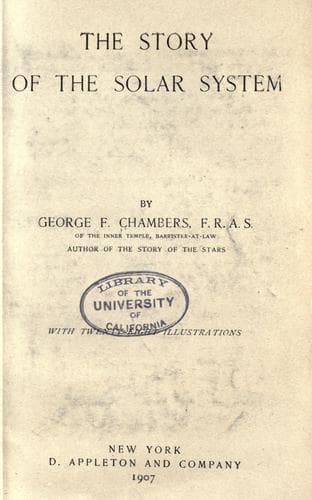
The Story of the Solar SystemChambers, George F. (George Frederick)
Science
The Story of the Solar System
Chambers, George F. (George Frederick)
Solar system
In former times the philosophers who studied the solar system ranged
themselves in several “schools of thought,” to use a modern hackneyed
phrase. Some upheld the Ptolemaic system, which took its name from a
great Egyptian astronomer, Claudius Ptolemy, though it does not appear
that he was actually the first to suggest it. The Ptolemaic system
regarded the Earth as the centre, with the following bodies, all called
planets, revolving round it in the order stated:—the Moon, Mercury,
Venus, the Sun, Mars, Jupiter, and Saturn. It will be observed that
there are seven bodies here named, and as seven was regarded as the
“number of perfection,” it was in later times considered that only these
seven bodies (neither more nor less) could really be the Earth’s
celestial attendants. Though Ptolemy was in one sense an Egyptian, there
yet prevailed amongst the Egyptians at large another theory slightly
different from Ptolemy’s. According to the “Egyptian theory,” Mercury
and Venus were regarded as satellites of the Sun, and not as primary
planets appurtenant to the Earth.
After Ptolemy’s era many centuries elapsed, during which the whole
subject of the solar system lay practically dormant, and it continued so
until the revival of learning brought new theorists upon the scene. The
most important of these was Copernicus, who, in the sixteenth century,
propounded a theory which eventually superseded all others, and, with
slight modifications, is the one now accepted. Copernicus placed the Sun
in the centre of the system, and treated it as the point around which
all the primary planets revolved. So far, so good; but Copernicus went
astray on the question of the orbits of the planets. He failed to
realise the true character of the curves which they follow and treated
these curves as “epicycles,” which word may be described as representing
a complicated combination of little circles which taken together form a
big one. It was left to Kepler and Newton to settle all such details on
a true and firm basis. But before this stage was reached a man of the
highest astronomical attainments and practical experience, Tycho Brahe,
made shipwreck of his reputation as an astronomer by solemnly reviving
the idea of the Earth being the immovable centre of everything. He
treated the Moon as revolving round the Earth at no great distance and
the Sun as doing the same thing a little farther off; the five planets
revolving round the sun as solar satellites. The “Tychonic system,” as
it is called, has something in common with the Ptolemaic system without
being by any means as logical as the latter. That such far-fetched ideas
as Tycho’s should have been palmed off on the world of science so
recently as 300 years ago is passing strange; but the explanation
appears to be that his action arose out of a misconception of certain
passages of Holy Scripture, which seemed irreconcilable with the
Copernican theory. It must not be forgotten that Copernicus’s famous
Public-domain text, read in full here on John Shaqi.
Reviews
Reviews
No reviews yet
Be the first to share your thoughts on this work.
Join the Discussion
Join the discussion
Sign in to leave a comment or review.
Sign InorCreate an account