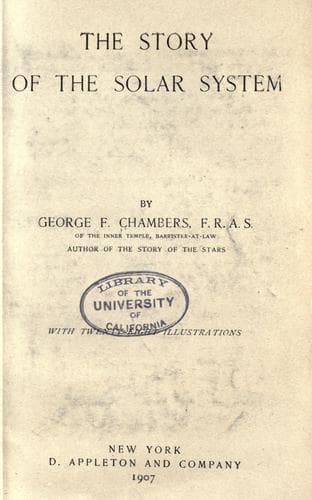
The Story of the Solar SystemChambers, George F. (George Frederick)
Science
The Story of the Solar System
Chambers, George F. (George Frederick)
Solar system
The physical peculiarities which the planets have in common include the
following points:—they are opaque bodies, and shine by reflecting light
which they receive from the Sun. Probably all of them are endued with an
axial rotation, hence their inhabitants, if there are any, have the
alternation of day and night, like the inhabitants of the Earth, but the
duration of their days, measured in absolute terrestrial hours, will in
most cases differ materially from the days and nights with which we are
familiar.
I stated on a previous page that, owing to the circumstances in which we
find ourselves on the Earth, the apparent and real movements of the
planets are widely different. It would be beyond the scope of this
little work to go into these differences in any considerable detail;
suffice it then to indicate only a few general points. In the first
place, an important distinction exists between the visible movements of
the inferior and superior planets. The inferior planets, Mercury and
Venus, lying as they do within the orbit of the Earth, are much
restricted in their movements, in the sky. We can never see them except
when they are more or less near to the rising (or risen) or setting (or
set) Sun. The extreme angular distance from the Sun in the sky to which
Mercury can attain is but 27°, and therefore we can never observe it
otherwise than in sunlight or twilight, for it never rises more than 1½
hours before sunrise nor sets later than 1½ hours after sunset. Of
course between these limits the planet is above the horizon all the time
that the Sun is above the horizon, but except in very large telescopes
is not usually to be detected during the day-time. These remarks
regarding Mercury apply likewise in principle to Venus; only the orbit
of Venus being larger than the orbit of Mercury, and Venus itself being
larger in size than Mercury, the application of these principles leads
to somewhat different results. The greatest possible distance of Venus
may be 47° instead of Mercury’s 27°. Venus is therefore somewhat more
emancipated from the effects of twilight. The body of Venus being also
very much larger and brighter than the body of Mercury, it may be more
often and more easily detected in broad daylight.
Public-domain text, read in full here on John Shaqi.
Reviews
Reviews
No reviews yet
Be the first to share your thoughts on this work.
Join the Discussion
Join the discussion
Sign in to leave a comment or review.
Sign InorCreate an account