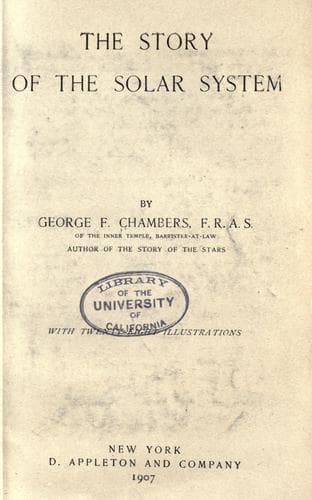
The Story of the Solar SystemChambers, George F. (George Frederick)
Science
The Story of the Solar System
Chambers, George F. (George Frederick)
Solar system
Planets. Distance: Bode’s Law. True distance from Sun.
Mercury 4 3.9
Venus 7 7.2
Earth 10 10.0
Mars 16 15.2
[Ceres] [28] [27.7]
Jupiter 52 52.0
Saturn 100 95.4
[Uranus] [196] [191.8]
[Neptune] [388] [300.0]
Bode having examined these relations and noticing the void between 16
and 52 (Ceres and the other minor planets, and Uranus and Neptune also,
being then unknown) ventured to predict the discovery of new planets,
and this idea stimulated him to organise a little company of astronomers
to hunt for new planets. Before, however, this scheme was got into
working order, Piazzi, director of the Observatory at Palermo, on
January 1, 1801, noted an 8th magnitude star in Taurus, which on the
next and succeeding nights he saw again, and found had moved. He
observed the strange object for 6 weeks, when illness interrupted him.
However he wrote letters announcing what he had seen, one of them to
Bode himself; but this letter, though dated Jan. 24, did not reach Bode
at Berlin, till March 20—a striking illustration of the state of the
Postal service on the Continent less than 100 years ago. The new body,
at first assumed to be a tailless comet, was eventually recognised to be
a new planet; and the name of Ceres, the tutelary goddess of Sicily, was
at Piazzi’s instance bestowed upon it.
Looking for Ceres in March, 1802, Olbers at Bremen, came upon another
new planet, which was afterwards named Pallas. At first he thought he
had got hold of a new variable star, but two hours sufficed to show that
the object under notice was in motion. The two new bodies were found to
be so much alike in size and appearance, and in their orbits, that
Olbers suggested both were but fragments of some larger body which had
been shattered by some great convulsion of nature. The idea was a daring
one, and it was an attractive one, though now regarded as untenable.
However it served the purpose of stimulating research, and the discovery
of Pallas was followed by that of Juno, by Harding, at Lilienthal 1804;
and of Vesta, by Olbers, at Bremen in 1807.
Public-domain text, read in full here on John Shaqi.
Reviews
Reviews
No reviews yet
Be the first to share your thoughts on this work.
Elsewhere in the archive
Join the Discussion
Join the discussion
Sign in to leave a comment or review.
Sign InorCreate an account