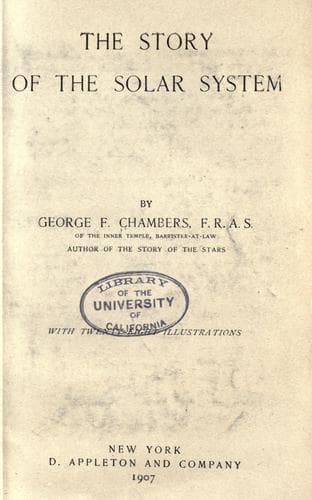
The Story of the Solar SystemChambers, George F. (George Frederick)
Science
The Story of the Solar System
Chambers, George F. (George Frederick)
Solar system
The organised search for minor planets was relinquished in 1816,
presumably because no more planets seemed to be forthcoming, and it does
not appear that any further attempts were made by anybody till about
1830, when a Prussian amateur, named Hencke of Driessen, profiting by
the publication of some new star maps put forth by the Berlin Academy,
commenced a methodical search for small planets. These Berlin maps, one
for each hour of R. A., were only completed in 1859, and, therefore,
Hencke had only a small number of them at his command during the early
years of his labours. Still it is strange that 15 years elapsed before
his zeal and perseverance were rewarded, his first discovery, the planet
Astræa, not taking place till December 1845. Once however the ice was
broken new planets followed with considerable rapidity, and beginning
with 1847, no year has elapsed without several or many having been
found. During the last decade the number detected annually has been very
great—sometimes as many as 20 in a year, but this has been the result of
photography being brought to bear on the work. It is obvious that if a
photograph of a given field taken on any one day is compared with a
photograph taken a few days earlier or later, and any of the objects
photographed have moved, their change of place will soon be noticed and
will be a distinct proof of their planetary nature.
It seems quite certain that all the larger of these planets have now
been found, for the average brilliancy (and this no doubt means the
average size) of those recently discovered has been steadily diminishing
year by year, and it looks as if the limit of visibility will soon be
reached, if it has not been reached already.
The three largest of these bodies, in order of size, have generally been
thought to be Vesta, Ceres, and Pallas; but Barnard, from observations
made in 1894, concluded that Ceres is 520 miles in diameter; Pallas, 304
miles; and Vesta, 241 miles. As to all the rest of the minor planets,
excepting Juno, Hornstein is of opinion that those having a greater
diameter than 25 geographical miles are few in number, and that the
majority of them are no larger than from 5 to 15 miles in diameter.
Public-domain text, read in full here on John Shaqi.
Reviews
Reviews
No reviews yet
Be the first to share your thoughts on this work.
Elsewhere in the archive
Join the Discussion
Join the discussion
Sign in to leave a comment or review.
Sign InorCreate an account