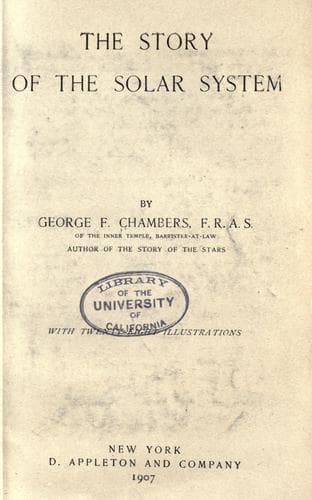
The Story of the Solar SystemChambers, George F. (George Frederick)
Science
The Story of the Solar System
Chambers, George F. (George Frederick)
Solar system
Under all circumstances they lie practically parallel, or nearly so, to
the planet’s equator. It is generally thought that the planet, whatever
may be its actual structure or constitution, is surrounded by a dense
cloudy envelope, and that the shaded streaks which we call belts are
rifts in this atmosphere, which expose to view the solid body of the
planet underneath. Whether, however, the term “solid body” is an
accurate one to be used in this connection is thought by some to be open
to doubt. The laws which regulate the existence of these belts are quite
unknown; indeed it seems doubtful whether any laws exist at all, for the
belts at one time appear to undergo constant change, whilst at another
time they remain almost unchanged for several months. It has been
suggested that when the changes are rapid it must be presumed that great
atmospheric storms are to be considered as in progress, and possibly
this may be the true explanation. Belts are commonly non-existent
immediately under the equator; whilst north and south of this void space
it most usually happens that there is one broad belt and several
narrower ones in each hemisphere. At each pole the planet’s brightness
is less than the average brightness, but it cannot exactly be said that
this is due to the existence there of belts properly so called.
It was formerly considered that no tinges of colour could be traced on
Jupiter except a silvery gray of different degrees of intensity; but
during the last thirty years there can be no doubt that shades of brown,
red, and orange, of no great depth, but yet quite definite have been
traceable. Many observers concur in this opinion. Whether this detection
of colour is due to an absolute development of colour during the period
in question; or whether its detection is merely the result of more
careful scrutiny with better instruments is a matter as to which the
evidence is not clear. Though the general position of the belts is such
that they are parallel to the planet’s equator, yet there are sometimes
exceptions to this rule, for in a few very rare instances a streak in
the nature of a narrow belt has been seen, inclined to the equator at a
decided angle, perhaps 20° or even more.
Public-domain text, read in full here on John Shaqi.
Reviews
Reviews
No reviews yet
Be the first to share your thoughts on this work.
Elsewhere in the archive
Join the Discussion
Join the discussion
Sign in to leave a comment or review.
Sign InorCreate an account