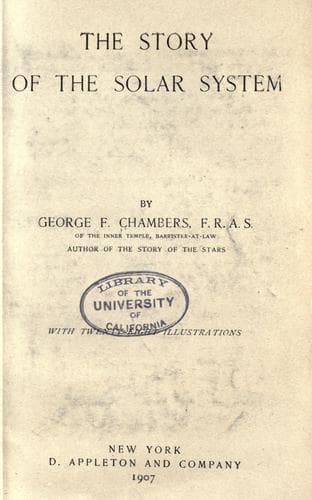
The Story of the Solar SystemChambers, George F. (George Frederick)
Science
The Story of the Solar System
Chambers, George F. (George Frederick)
Solar system
From what has gone before the reader will readily infer that these minor
planets are of no sort of interest to the casual amateur who dabbles in
Astronomy; and indeed that they are of very little interest to anybody.
With a few general statistics, therefore, this chapter may be concluded.
The total number of minor planets now known nearly reaches 500, and
every year increases the list; but not, however, at as rapid a rate as
was once the case, because the German mathematicians, who alone latterly
have been willing to trouble themselves with the computation of the
orbits, are understood to have announced that they are no longer able to
keep pace with the discoveries made. Those who care to investigate in
detail the circumstances of these planets will find great extremes in
the nature of the orbits. Whilst the planet nearest to the Sun has a
period of only 3 years, the most distant occupies nearly 9 years in
performing its journey round the Sun. So, also, there are great
differences in the eccentricities of the orbits and in their
inclinations to the ecliptic. Whilst one planet revolves almost in the
plane of the ecliptic, another (Pallas) has an orbit which is inclined
no less than 34° to the ecliptic. One word, in conclusion, as to the
names applied to these bodies. At the outset the names given were,
without exception, chosen from the mythologies of ancient Greece and
Rome, but, latterly, the most fantastic and ridiculous names have in
many cases been selected, names which in too many instances have served
no other purpose than that of displaying the national or personal vanity
of the astronomers who applied them to the several planets. The French
are great offenders in this matter.
CHAPTER IX.
JUPITER.
The planet Jupiter occupies, in one sense, the first position in the
planetary world, it being the largest of all the planets. Moreover, with
the exception of Venus, it is the brightest of the planets. As with
Mars, and for the like reason, Jupiter, when in the positions known as
the Quadratures (or near thereto), exhibits a slight phase, but owing to
the far greater distance from the Sun of Jupiter, compared with Mars,
the deviation of the illuminated surface from that of a complete circle
is very small; it is, however, perceptible at or near the time of
quadrature, a slight shading off of the limb farthest from the Sun being
traceable.
Jupiter is noteworthy on account of two features, both of them more or
less familiar, at least by name, to most people—its belts and its
satellites,—both of which will be described in due course.
The belts are dusky streaks, which vary from time to time both in
breadth and number: most commonly two broad belts will be seen with two
or three narrower ones on either side; but sometimes all are rather
narrow, and their narrowness is made up for by an increase in their
number.
[Illustration: Fig. 14.—Jupiter, November 27, 1857 (Dawes).]
Public-domain text, read in full here on John Shaqi.
Reviews
Reviews
No reviews yet
Be the first to share your thoughts on this work.
Elsewhere in the archive
Join the Discussion
Join the discussion
Sign in to leave a comment or review.
Sign InorCreate an account